


Air Conditioner
The Complete Guide to Mini Split vs Central AC Cost Comparison
Is a Mini Split or Central AC the Better Investment for Your Home?
When it comes to a mini split vs central AC cost comparison, the honest answer is: it depends almost entirely on one thing — whether your home already has ductwork in good condition.
Here is a quick breakdown to help you decide fast:
| Factor | Mini Split | Central AC |
|---|---|---|
| No existing ductwork | Strong advantage | Major added expense |
| Existing good ductwork | Higher upfront cost | Lower upfront cost |
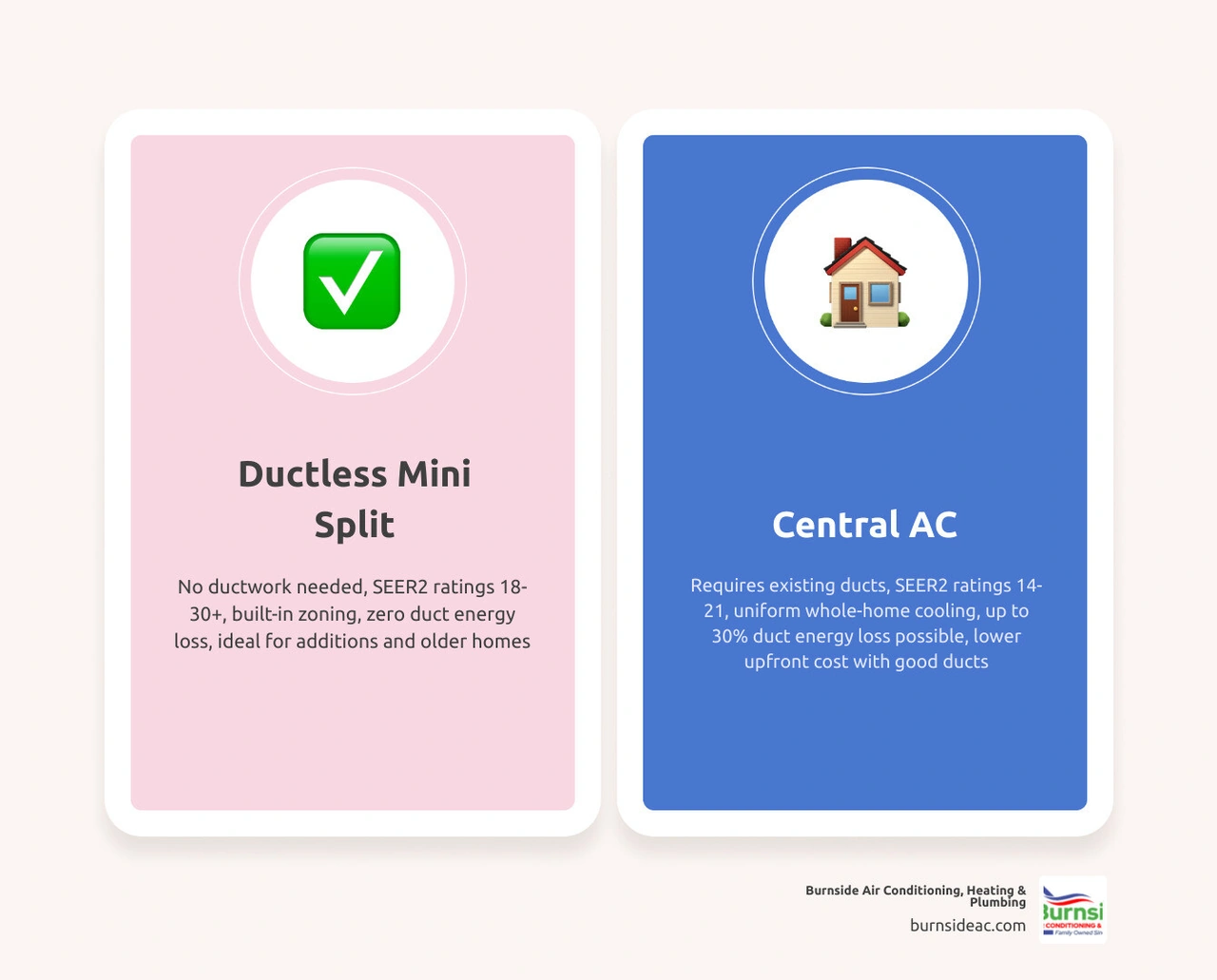
| Energy efficiency (SEER2) | 18–30+ | 14–21 |
| Duct energy loss | None | Up to 20–30% |
| Zoning capability | Built-in, per room | Requires add-ons |
| Best for | Additions, older homes, zoning | Whole-home, existing ducts |
| Federal tax credit available | Up to $2,000 (heat pump) | Up to $600 |
For most homeowners in McKinney and the surrounding Collin County area, the decision comes down to three questions: Do you have ducts? How many rooms need cooling? And how long do you plan to stay in the home?
If your ducts are old, leaky, or simply nonexistent, a ductless mini split will almost always come out ahead — both on installation cost and on your monthly energy bill. If your ductwork is in solid shape and you want consistent whole-home cooling from a single system, central AC is typically the more practical upfront choice.
The sections below walk through every cost factor in detail — from equipment and installation to energy savings, maintenance, and available rebates — so you can make a confident, informed decision for your home.
Key terms for mini split vs central ac cost comparison:
The Core Factors of a Mini Split vs Central AC Cost Comparison
When evaluating a mini split vs central ac cost comparison, we must look beyond the initial purchase price. A true financial comparison balances the relative upfront investment against the long-term operational value of each system. In North Texas, where summer temperatures regularly climb into the triple digits, your HVAC choice will impact your household budget for the next 15 to 20 years.
To make an accurate comparison, we must analyze how your home layout, zoning desires, and local climate interact with each technology. Our team often sees homeowners make the mistake of choosing a system based solely on the lowest installation bid, only to pay significantly more in utility bills and repair fees down the road.
For a comprehensive breakdown of how these systems stack up fundamentally, you can read our Central AC vs Ductless Mini Split Comparison.
How Existing Ductwork Influences Your Mini Split vs Central AC Cost Comparison
The single most significant variable in any HVAC cost comparison is the presence, age, and physical condition of your air ducts.
If your home does not have existing ductwork—which is common in historic McKinney properties, detached guest houses, or certain mid-century builds—installing a central AC system requires a massive structural retrofitting process. This involves cutting into plaster walls, lowering ceilings to build bulkheads, or sacrificing closet space to run sheet metal or flexible ducts. This construction work adds substantial labor and material expenses on top of the actual AC equipment purchase.
Conversely, a ductless mini split system requires only a small three-inch hole in the wall to connect the indoor air handler to the outdoor condenser via a copper refrigerant line and electrical wiring. This dramatically reduces installation complexity and eliminates the need for expensive drywall repairs and structural modifications.
For a detailed look at your options when retrofitting a home, refer to our guide on Adding Cooling Without Ductwork Options Compared.
Zoning and Efficiency Dynamics in a Mini Split vs Central AC Cost Comparison
Another major financial differentiator is how each system distributes conditioned air. Traditional central air conditioning is designed to cool your entire home uniformly. When the thermostat in your living room calls for cooling, the system pumps chilled air to every single register in the house, regardless of whether those rooms are occupied. This leads to substantial energy waste in empty guest rooms, formal dining areas, or unoccupied bedrooms during the day.
Ductless mini split systems offer built-in, room-by-room zoning by default. Each indoor unit operates independently with its own thermostat. If you spend your daytime hours in a home office in Frisco or Plano, you can cool only that specific room while letting the rest of the house remain warmer.
This localized temperature control is powered by variable-speed inverter technology. Unlike standard central AC compressors that cycle completely on and off (consuming massive spikes of electricity each time they start), inverter-driven mini splits run continuously at lower speeds, matching the precise cooling load of the room.
To learn more about how this works in local homes, check out our article on Mini Split Zoning in Mckinney and explore the broader Benefits of a Home Ductless AC.
Energy Efficiency and Monthly Utility Bill Impact
To understand the long-term return on your investment, we have to look at seasonal energy efficiency ratio (SEER2) ratings and real-world operating conditions. As of 2026, SEER2 is the strict industry standard used to measure cooling efficiency under realistic static pressure conditions.
Standard central air conditioning systems typically achieve SEER2 ratings ranging from 14 to 21. High-efficiency ductless mini split systems, on the other hand, frequently achieve SEER2 ratings from 18 to 30+, with some ultra-premium models reaching even higher.
Furthermore, the U.S. Environmental Protection Agency (EPA) and the Department of Energy's Energy Star program highlight a critical flaw in ducted systems: central air systems typically lose 20% to 30% of their conditioned air through duct leaks, gaps, and poor insulation. Because mini splits bypass ducts entirely, they deliver 100% of the cooled air directly into your living space, maximizing every watt of electricity you pay for.
For a deeper dive into these efficiency metrics, see our Ductless Mini Split Systems Complete Guide.
Duct Losses vs. Direct Air Delivery
Thermal conduction and duct leakage are silent budget killers. When attic temperatures in Collin County soar during July, any ductwork running through that unconditioned space absorbs heat. This thermal conduction warms the air inside your ducts before it ever reaches your vents, forcing your central AC to work significantly harder and run longer cycles.
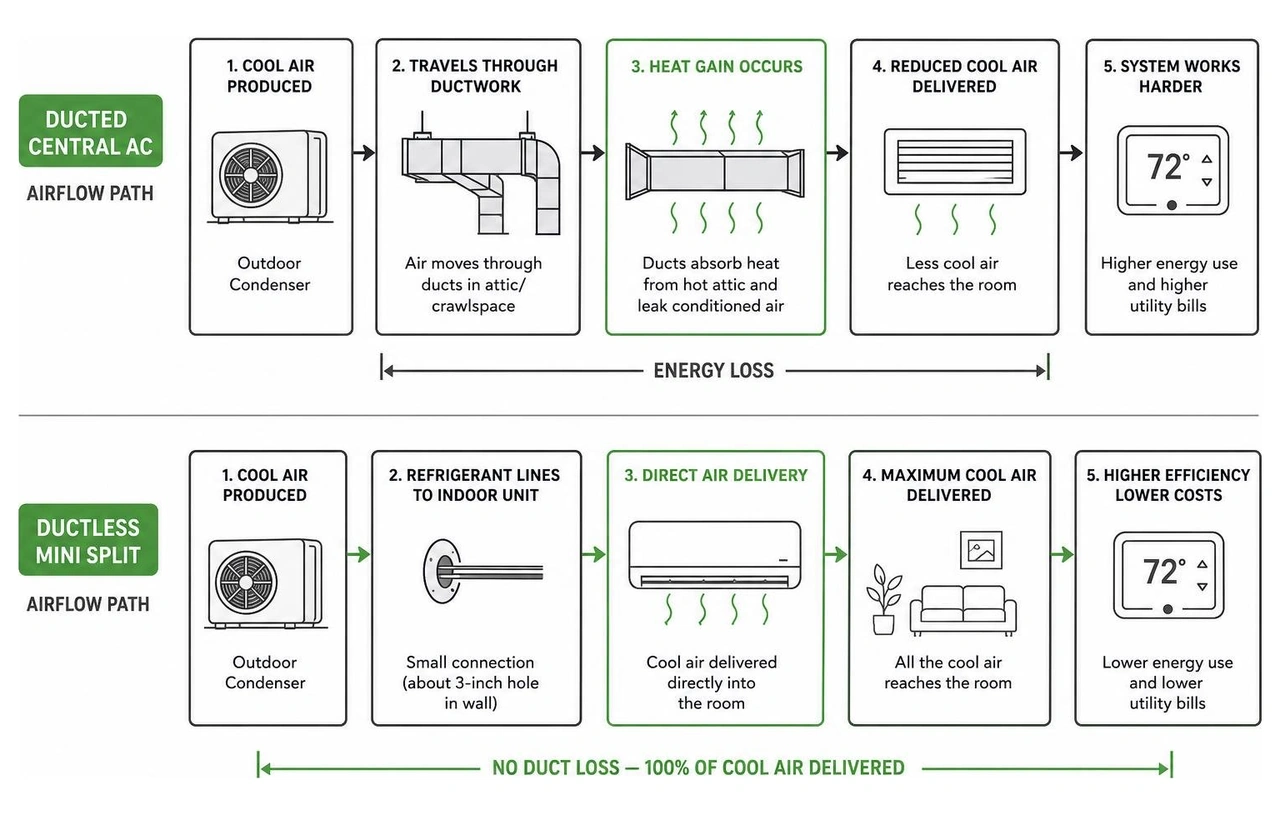
By delivering air directly from the indoor coil into the room, mini splits avoid both duct leakage and thermal conduction losses entirely. This direct delivery system is a cornerstone of modern energy conservation, allowing homeowners to reduce their cooling electricity usage by 25% to 40% compared to standard central systems.
To weigh these pros and cons further, read about The Pros and Cons of Mini Split HVAC Systems.
Inverter Compressors and Variable-Speed Performance
Standard single-stage central AC units operate on a simple binary principle: they are either running at 100% capacity or they are completely off. This constant cycling creates frequent power consumption spikes and leads to noticeable temperature swings.
Ductless mini splits utilize advanced inverter-driven variable-speed compressors. These systems ramp up to reach your desired temperature quickly, then drop down to a steady-state, low-power mode to maintain that exact temperature. This continuous, low-speed operation not only prevents energy-wasting start-stop cycles but also provides superior humidity control—a vital benefit during humid North Texas summers.
When to Choose Ductless Technology vs. Central Forced Air
Because every home in our service area is unique, there is no single "right" choice. The decision to install a mini split or a central AC system depends on your specific renovation plans, existing infrastructure, and comfort goals.
For example, homeowners looking to optimize specific spaces can consult our guide on the Best Rooms for a Mini Split System.
Ideal Scenarios for Ductless Mini Splits
Ductless mini splits are the premier financial and practical choice in several common scenarios:
- Garage Conversions & Workshops: Turning a garage into a home gym, office, or workshop in Prosper or Celina is incredibly popular. Extending bulky ductwork from your main central system is often impossible or overloads your existing equipment. A single-zone mini split solves this perfectly.
- Room Additions & Sunrooms: Adding a new room without upgrading your central system to a larger size is a major challenge. A mini split handles the new space independently.
- Historic Home Preservation: For older homes in downtown McKinney or historic areas of Plano, installing ducts would require destroying historic plaster walls and original woodwork. Mini splits preserve the home's historic integrity.
- Addressing "Nuisance Rooms": If you have a second-story bedroom or a sunroom that never stays cool, a mini split can provide targeted supplemental cooling.
For more on local applications, read about installing Ductless Mini Splits Mckinney Home and view our Mini Split vs Window Unit Comparison.
When Central AC Remains the Practical Choice
Despite the incredible efficiency of mini splits, traditional central forced air remains the most practical and cost-effective choice in many situations:
- Existing Ductwork in Good Shape: If your home already has a well-designed, sealed duct network that is under 15 years old, replacing an aging condenser and coil with a new high-efficiency central AC unit is highly cost-effective upfront.
- Uniform Whole-Home Cooling: If you prefer a single, centralized thermostat control and want every room in your house kept at the exact same temperature, central AC excels.
- Aesthetics and Invisible Comfort: Homeowners who dislike the visual presence of wall-mounted indoor units often prefer central systems, where the only visible elements are flush-mounted ceiling registers.
- Advanced Indoor Air Quality Integration: Central systems easily accommodate whole-home air purifiers, humidifiers, and high-MERV filtration systems directly within the duct return, treating your entire home's air supply simultaneously.
For a comparison of whole-home traditional options, see Central AC vs Window Units.
Hidden and Long-Term Total Cost of Ownership Factors
To calculate the true lifecycle cost of your HVAC system, you must look beyond the initial installation invoice. Total cost of ownership includes ongoing maintenance, filtration needs, aesthetic choices, and how the system responds to industry-wide changes like the ongoing environmental refrigerant transition.
Maintenance and Filtration Requirements
Both systems require regular attention to maintain peak efficiency, but their day-to-day requirements differ:
- Mini Split Filter Cleaning: Ductless indoor units have small, high-density plastic filters that must be rinsed or vacuumed every 2 to 4 weeks during heavy use. Neglecting this quickly restricts airflow, reduces cooling capacity, and can cause condensate water leaks inside your home.
- Central AC Filter Replacement: Central systems typically use larger pleated media filters located in a central return grille or equipment closet, which only need to be replaced every 1 to 3 months.
- Professional Inspections: While a central system requires one comprehensive annual professional inspection, a multi-zone mini split system requires our technicians to inspect and service multiple individual indoor air handlers, condensate drain lines, and outdoor connections, which can alter long-term maintenance labor requirements.
Financial Incentives, Rebates, and Tax Credits
The federal government and local utilities offer significant financial incentives to help offset the upfront cost of high-efficiency HVAC upgrades:
- Energy Efficient Home Improvement Credit (Section 25C): Homeowners can claim a federal tax credit of up to 30% of the project cost (capped at a maximum of $2,000 per year) for qualifying Energy Star certified heat pump mini splits. Traditional central AC systems only qualify for a maximum credit of $600.
- Utility Rebates: Many local electric cooperatives and municipal utility providers in Collin County offer cash-back rebates for upgrading to high-SEER2 equipment.
- Payback Periods: High-efficiency mini split systems typically pay back their initial efficiency premium within 3 to 5 years through reduced monthly utility bills, especially in hot climates with long cooling seasons.
Frequently Asked Questions About Home Cooling Upgrades
Is a mini split more efficient than central air conditioning?
Yes, in almost all cases. Mini splits achieve significantly higher SEER2 ratings (frequently exceeding 25 to 30 SEER2) compared to high-end central AC systems, which typically top out around 21 to 26 SEER2. Additionally, because mini splits deliver air directly into the room, they completely eliminate the 20% to 30% energy loss caused by duct leaks and thermal conduction.
Can a ductless mini split replace a traditional furnace for heating?
Absolutely. Most modern mini splits are heat pumps, meaning they can reverse the cooling process to provide highly efficient heating during the winter. These systems extract ambient heat from the outdoor air and pump it indoors, operating up to three times more efficiently than traditional gas or electric resistance furnaces. Modern cold-climate heat pumps can maintain reliable heating capacity even when outdoor temperatures drop well below freezing.
How does the installation timeline compare between the two systems?
A single-zone mini split installation is incredibly fast and minimally invasive, often completed in just 4 to 8 hours. A multi-zone whole-home mini split system typically takes 1 to 2 days. In contrast, installing a new central AC system in a home that requires complete ductwork construction can take anywhere from 4 to 7 days, involving significant disruption, dust, and subsequent drywall repairs.
Conclusion
Choosing between a mini split and central air conditioning is a major decision that shapes your home's comfort and utility expenses for decades. At Burnside Air Conditioning, Heating & Plumbing, we have served McKinney, Frisco, Allen, Plano, and the surrounding Collin County communities since 1958. As a family-owned local business, we prioritize accurate diagnostics, expert solutions, and American-made parts to deliver our signature "Gold Star Standard" of service.
Whether you need to cool a new home addition, preserve a historic property, or replace an aging central system, our experienced, licensed technicians are here to help you find the most efficient and cost-effective solution for your unique layout.
Schedule a professional consultation for your home's cooling upgrade with our team today, and let us help you achieve dependable, year-round comfort.
Other Blog Posts
Customer Testimonial
Hear What Our Customers Say About Their Burnside Experience


I usually don’t leave reviews but Burnside AC really impressed me both times I’ve used them. They were honest and affordable, and they worked around my schedule without any problem. Every technician I met was pleasant, professional, and willing to go above and beyond to make sure everything was done right. It’s rare to find a company you can truly trust, and I highly recommend them.
Jason was excellent. Extremely knowledgeable and very professional. I am really happy with the service he provided, as well as conversing with him personally. I highly recommend him and Burnside. Will definitely be referring Jason and Burnside to family and friends in need of service. Thanks again, Jason!
Thank you Burnside for your great customer service and excellent maintenance team! H.B. completed our fall checkup today in a timely manner and was very friendly and professional. Appreciate you all!
"We have used Burnside for nearly 30 years. They have always been prompt, polite, and professional. Our latest request was a disconnect. You can be sure Burnside's phone will ring as soon as new service is required!"
"I am so impressed with Burnside!!! I will never even consider using anyone else. I was u def a lot of pressure and the heating system was not working correctly and they found a minor inexpensive solution. Another local vendor charged way more for a similar situation. I immediately sighed up for their annual program. God bless them."
"I had Burnside install a new A/C system a few years ago. They did a great job and have returned on a few occasions to perform maintenance. Their technicians are well trained, knowledgeable and courteous. I would highly recommend them for your A/C and heating needs!"
"This crew who installed both of our HCAC units were very good. They worked hard for over 8 hours so we did not have to worry about getting uncomfortable with both units down. Would recommend Burnside to family and friends."
"Excellent inspection and service by Jacob McCormick. He was very efficient, personable and professional. We would like to request him for our future inspections. A first class job!"
"I cannot praise Tim enough for coming to our rescue! We were having issues with rooms over heating and getting too cold, and he was at our house with quickness to resolve the issue!"
.webp)