
The Ultimate Guide to Gas vs Electric Water Heater
Burnside Air Conditioning, Heating & Plumbing

Gas or electric water heater? The best choice depends on your home's setup, hot-water demand, and utility rates. This guide compares efficiency, recovery rate, lifespan, and cost so you can decide fast.
Gas vs Electric Water Heater: Which Is Better for Your McKinney, TX Home?
When it comes to gas vs electric water heater which is better, the honest answer is: it depends on your home's existing setup, your household's hot water demand, and your local utility rates. Neither type wins in every situation — but understanding the key differences makes the decision much clearer.
Here's a quick breakdown to help you decide fast:
| Factor | Gas Water Heater | Electric Water Heater |
|---|---|---|
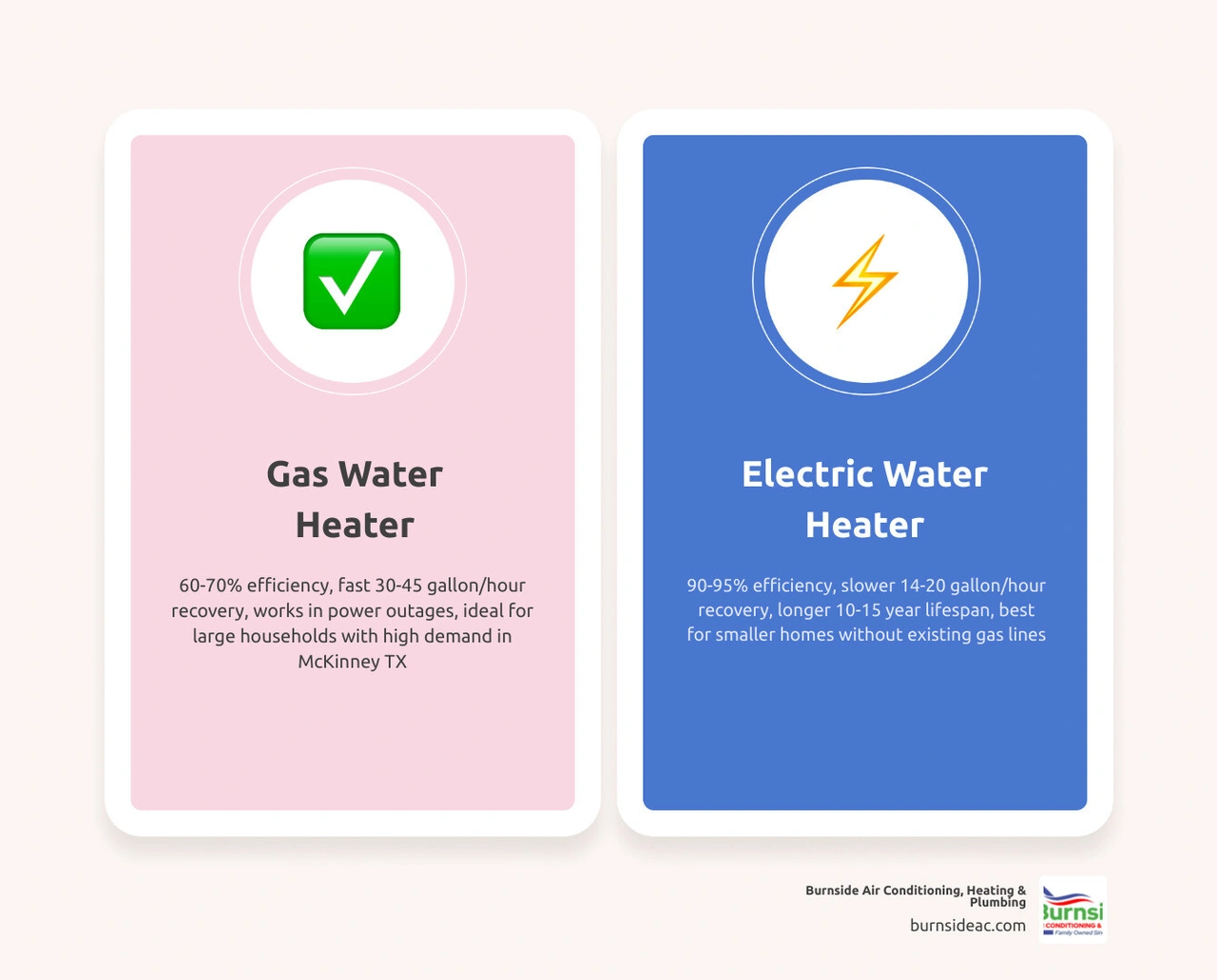
| Energy efficiency | 60–70% | 90–95% |
| Recovery rate | 30–45 gallons/hour | 14–20 gallons/hour |
| Lifespan | 6–12 years | 10–15 years |
| Works during power outage? | Yes (with pilot light) | No |
| Best for | Large households, high demand | Smaller households, no gas line |
| Installation complexity | Higher (venting required) | Lower (if 240V circuit exists) |
Your water heater runs every single day — quietly, in the background — until it doesn't. And when it fails, you need answers fast. For homeowners in McKinney, TX and across Collin County, choosing between gas and electric comes down to what's already in your home, how much hot water your family actually uses, and what energy costs look like in your area.
Gas heaters heat water faster and tend to cost less to operate month to month in most Texas markets where natural gas is relatively affordable. Electric heaters convert more of their energy into heat, cost less upfront, and typically last longer. And then there's a third option — heat pump water heaters — that has quietly become the most cost-efficient choice for many homeowners, beating both gas and standard electric on annual operating costs.
This guide walks you through everything you need to know to make a confident, informed decision.
Core Differences: How Gas and Electric Water Heaters Work
To truly evaluate which system fits your home, it helps to understand how they generate heat. While both styles are designed to keep a large tank of water at a comfortable, steady temperature (usually around 120°F), they use completely different mechanisms to achieve this goal. For a deeper dive into these mechanical differences, check out our Gas vs Electric Water Heater Complete Guide.
Gas Water Heaters and Combustion Heating
Gas water heaters rely on combustion to heat your water. When the thermostat inside the tank detects that the water temperature has dropped, a control valve releases gas to a burner located at the bottom of the tank. A pilot light or electronic spark ignites the burner, and the resulting flame heats the bottom of the water tank.
Because combustion produces toxic gases like carbon monoxide, gas units must vent these byproducts safely out of your home. This requires a dedicated chimney or vent pipe running through your roof or an exterior wall. Traditional atmospheric models use natural draft venting, while power-vent models use an electric fan to push exhaust gases outside. To learn more about how these units are integrated into your home's gas infrastructure, read about our services for Gas Electric Water Heaters.
One of the primary benefits of this combustion process is speed. Gas burners transfer heat to water incredibly fast, giving them a high recovery rate (how quickly the tank reheats after being emptied).
Electric Water Heaters and Resistance Heating
Electric water heaters use electric resistance heating elements that plunge directly into the water inside the tank. Most standard residential tanks feature two elements: one near the bottom and one near the top. When the water cools down, the thermostat sends electricity to these elements, which heat up like the coils on an electric stovetop or toaster.
Because there is no combustion, electric water heaters do not produce any exhaust gases. This means they do not require venting systems, pilot lights, or gas lines, making them simpler to design and install. However, because electric elements take longer to transfer heat to the surrounding water, their recovery rates are naturally slower than their gas-powered counterparts. For a comprehensive comparison of how these heating methods stack up, take a look at our article on Which Water Heater Type is More Efficient.
Gas vs Electric Water Heater Which Is Better for Efficiency and Operating Expenses?
When homeowners ask us about gas vs electric water heater which is better, they are usually thinking about their monthly utility bills. While electric water heaters are technically more efficient at converting energy into hot water, local utility rates in North Texas often tip the operational cost advantage in favor of gas.
Evaluating Monthly Utility Bills and Energy Efficiency
To understand water heater efficiency, we look at the Uniform Energy Factor (UEF). The UEF measures how much of the energy put into the water heater is actually transferred to the water as heat.
- Standard Electric Tanks: These boast a UEF of 90% to 95%. Because the heating elements are fully submerged in the water, almost 100% of the electricity used is converted directly into heat. There is no heat lost through a vent pipe.
- Standard Gas Tanks: These typically have a UEF of 60% to 70%. A significant amount of heat is lost as exhaust gases escape through the venting system.
Despite being less efficient on paper, gas models are often cheaper to run month-to-month. This is because natural gas is generally less expensive per unit of energy than electricity in our region. However, if you are looking to maximize efficiency, there are several advanced options available. You can read more about these in our guide to Energy Efficient Water Heater Options Explained.
Lifespan and Maintenance Trade-offs
The long-term value of a water heater also depends on how long it lasts and how much maintenance it requires.
Electric water heaters generally have a longer lifespan, typically lasting 10 to 15 years. Because they have fewer moving parts and do not experience the intense physical stress of open flames and combustion, their components wear out more slowly.
Gas water heaters usually last between 6 to 12 years. The constant cycle of heating and cooling from the gas burner causes the metal tank to expand and contract, which can accelerate wear and tear over time. To understand what factors influence these timelines, check out our resource on How Long Does a Water Heater Last.
Regardless of fuel type, both systems require regular maintenance to combat hard water. In cities like Plano, Frisco, and McKinney, sediment can build up at the bottom of the tank, reducing efficiency and causing hot spots that damage the tank lining. Homeowners should flush their water tanks at least once a year and have the anode rod inspected every three to five years to prevent internal corrosion.
Performance, Recovery Rates, and Daily Household Impact
How your water heater performs under pressure directly impacts your household's daily comfort. If you have ever had the hot water run out mid-shower because someone started the dishwasher, you know exactly how important peak performance is.
Why Recovery Rates Matter for Large Families
The recovery rate determines how quickly your water heater can provide a continuous supply of hot water during periods of heavy use.
- Gas Recovery Rate: Gas models typically recover 30 to 45 gallons of hot water per hour. This rapid heating capability makes them ideal for busy mornings when multiple family members need to shower back-to-back.
- Electric Recovery Rate: Standard electric models recover only 14 to 20 gallons of hot water per hour. If you empty a 50-gallon electric tank, you will have to wait significantly longer for the water to reheat.
Deciding if a Gas vs Electric Water Heater Which Is Better for High-Demand Homes
For larger households in communities like Allen, Prosper, or Celina, a gas water heater is often the preferred choice purely for its recovery speed. A 40-gallon gas water heater can often match or exceed the real-world performance of a 50-gallon electric unit because it replenishes its hot water supply so quickly. If your household has high simultaneous hot water demand, sticking with gas—or upgrading to a higher-capacity gas model—will keep everyone comfortable.
Determining if a Gas vs Electric Water Heater Which Is Better for Long-Term Efficiency
If you want the absolute highest long-term efficiency and are willing to consider modern electric technology, a hybrid heat pump water heater is an exceptional option.
Unlike standard electric resistance heaters, hybrid heat pump models pull heat from the surrounding air and transfer it to the water tank. This allows them to operate at 250% to 300% efficiency. In fact, a hybrid heat pump can reduce your water heating energy use by up to two-thirds compared to a standard electric tank.
Furthermore, regulatory shifts are coming. Under the 2029 Department of Energy (DOE) standards, conventional electric resistance tanks of certain sizes will be phased out for residential manufacturing in favor of highly efficient heat pump technology. Upgrading to a hybrid model now positions your home well ahead of these future standards.
Infrastructure Requirements and Alternative Hot Water Solutions
Before choosing a new water heater, you must evaluate your home's existing infrastructure. Switching from one fuel source to another is not always a simple swap and often requires significant modifications to your utility connections. To explore the differences between various tank setups, see our Tankless vs Tank Water Heater Comparison.
Upgrading and Switching Fuel Types
If you currently have a gas water heater and want to switch to electric, you cannot simply plug the new unit into a standard wall outlet. Electric water heaters require a dedicated 240-volt, 30-amp circuit. If your utility closet does not already have this electrical line, a licensed professional will need to run a new cable from your main electrical panel, which may require upgrading your home's electrical capacity. Additionally, the existing gas line must be safely capped, and the old exhaust vent must be sealed.
Conversely, switching from electric to gas requires running a new gas line to the water heater's location and installing a complete venting system through your walls or roof to handle combustion exhaust. Because of these infrastructure demands, most homeowners find it most practical to stick with their existing fuel type unless they are undergoing a major home renovation.
Tankless Water Heaters for Endless Hot Water
If you are looking to replace your water heater, you might want to move away from storage tanks entirely. Tankless (or demand-type) water heaters heat water instantly as it flows through the unit, completely eliminating standby energy losses.
Gas-fired tankless units provide exceptionally high flow rates, making them capable of supporting multiple showers simultaneously. While electric tankless units are available, they require a massive amount of electrical power, often necessitating expensive upgrades to your home's electrical panel.
If you are considering making the switch to an on-demand system, we invite you to explore our services for Tankless Water Heaters, read our Tankless Water Heater Guide 2026, or check out our local project spotlight on Tankless Water Heater Replacement in Fairview TX.
The Role of Expansion Tanks in System Safety
Regardless of whether you choose gas or electric, system safety is paramount. When water is heated, it expands. In a closed plumbing system, this thermal expansion can cause water pressure to spike, putting intense stress on your pipes, valves, and the water heater tank itself.
To prevent this, plumbing codes in McKinney and surrounding North Texas cities require the installation of an expansion tank. This small tank acts as a safety cushion, absorbing excess pressure to protect your plumbing system. You can learn more about how these safety devices work by reading What is an Expansion Tank for a Water Heater, understanding What Happens if Expansion Tank Fails, or reviewing our specialized services for Expansion Tanks.
Frequently Asked Questions About Water Heaters
Do gas water heaters work during power outages?
It depends on the type of gas water heater you have. Traditional gas water heaters that use a standing pilot light and a mechanical gas valve do not require electricity to operate, meaning you will still have hot water during a power outage. However, modern high-efficiency gas models—such as power-vented units or those with electronic ignitions—require electrical power to run the exhaust fan or ignite the burner. These units will not work during an outage unless they are connected to a backup generator or battery system. Electric water heaters will never function during a power outage.
Is it worth switching water heater types?
Switching fuel types is generally only worth the investment if you are already planning major electrical or structural renovations, or if you are transitioning your entire home to solar power. If your home has an existing gas line and proper venting, sticking with a gas water heater (or upgrading to a gas tankless system) is usually the most practical choice. If your home is entirely electric, switching to a modern hybrid heat pump water heater offers incredible energy savings without the need to run gas lines and install venting.
How do I know if my current water heater is gas or electric?
You can easily identify your water heater's fuel source by looking at the unit:
- Gas Water Heaters: Look for a metal vent pipe coming out of the top of the tank to carry away exhaust. You will also see a gas line (usually a yellow flexible metal pipe or black iron pipe) connected to a control valve near the bottom, and a small burner access window where you can sometimes see a blue flame.
- Electric Water Heaters: These units do not have vent pipes or gas lines. Instead, you will see a thick electrical cable (often enclosed in a metal conduit) entering the top or side of the tank, along with two removable metal access panels on the side of the tank that cover the heating elements.
Conclusion
Choosing the right water heater is a decision that will affect your home's comfort, safety, and utility bills for the next decade or more. Whether you decide that a fast-recovering gas unit, a highly efficient electric model, or an advanced tankless system is the best fit, professional installation is key to ensuring your system operates safely and reliably.
At Burnside Air Conditioning, Heating & Plumbing, we have been serving families across McKinney, Frisco, Allen, Plano, and Collin County since 1958. As a family-owned business, we prioritize accurate diagnostics, expert solutions, and the highest standard of customer service.
If you are ready to upgrade your home's hot water system or need professional guidance on which option is right for your household, explore our services for Water Heaters and contact us today for expert Water Heater Repair Installation.
Need Help?
Contact us today to discuss your needs. Our team is ready to help.
About the Author
Burnside Air Conditioning, Heating & Plumbing
More Articles
View All PostsRelated Articles

How Long Should a Typical Furnace Repair Service Take?
Waking up to a freezing house is stressful enough without guessing when your heat will return. We break down the exact timeline between diagnosing the issue and fixing your furnace.
Read Article
The Impact of Clogged Burners on Furnace Efficiency and Safety
Rust and debris can silently block your heating system's gas flow, creating hidden hazards. Learn to spot the signs of incomplete combustion early to protect your home.
Read Article
Why Tankless Water Heaters Need Specific Freeze Protection in Texas
Exterior-mounted tankless units are highly vulnerable to sudden Texas cold snaps. Understand the risks to your isolation valves and why professional winterization is the safest choice for your home.
Read Article
Navigating Gas Line Safety Inspections for Furnace Replacements in Prosper, TX
Replacing a failing heating system shouldn't mean drowning in municipal red tape. Discover what to expect during your mandatory town safety inspection.
Read Article
Programmable Thermostat Upgrades: Wi-Fi Connected vs. Local Control Only
Deciding between a high-tech smart thermostat and a reliable standard model can be confusing. We break down the pros and cons so you can confidently choose the right upgrade.
Read Article
Diagnosing a Clicking Sound Before the Furnace Ignites
When you turn on the heat during the first cold snap, rapid clicking from the HVAC closet can be startling. Find out if it's a normal spark igniter or a sign you need repairs.
Read Article
How Short Cycling Damages Your Furnace Blower Over Time
If your heating system constantly shuts down after just a few minutes, it's causing invisible mechanical wear. We break down why these short run cycles threaten your blower motor.
Read Article
Heating Solutions for Historic Homes in Downtown McKinney, TX
Upgrading the heat in your century-old property shouldn't mean tearing down original plaster. Discover non-invasive HVAC options that deliver modern comfort while preserving architectural charm.
Read Article
Tackling October Indoor Air Quality Challenges as Windows Stay Closed
When you shut your windows for the season, indoor VOCs and odors get trapped inside. Transitioning to active HVAC air management is the key to keeping your home fresh.
Read Article
Humidifier Integration: Bypass vs. Fan-Powered Systems for Dry Texas Winters
When Texas winters dry out your home, choosing between a bypass and a fan-powered humidifier is a critical decision. See how your specific HVAC layout dictates the right system.
Read Article
Does My Heat Pump Need a Defrost Cycle Check Before Winter?
Your heat pump has a hidden vulnerability when temperatures plummet. A proactive defrost cycle check in October is the best way to avoid a total freeze-up in January.
Read Article
How We Detect Microscopic Gas Leaks Around Your Furnace Manifold
Winter cold snaps put immense stress on heating systems, causing dangerous pinhole fissures. See why relying on your nose isn't enough and how our tools keep your family safe.
Read ArticleReady to Get Started?
Whether you need a repair, maintenance, or a new installation, our expert team is here to help.