


Guide
Where to Stick It: The Best Rooms for a Mini Split System

Why Choosing the Best Rooms for a Mini Split System Changes Everything in Your McKinney Home
The best rooms for a mini split system are bedrooms, living rooms, home offices, finished basements, garages, sunrooms, and converted attics — essentially any space where your central HVAC falls short.
Quick Answer: Top Rooms for a Mini Split
| Room | Why It Works |
|---|---|
| Master Bedroom | Whisper-quiet operation supports better sleep |
| Home Office | Targets heat from electronics; no noise disruption |
| Finished Basement | Controls humidity and extreme temperature swings |
| Converted Attic | Reaches spaces central ductwork can't |
| Garage / Workshop | Conditions unconditioned spaces year-round |
| Sunroom | Handles heavy solar gain central AC can't manage |
| Living Room | Offsets heat from occupants without affecting other rooms |
If you live in McKinney, Frisco, or anywhere across Collin County, you already know what North Texas summers feel like. The downstairs thermostat says 74°F, but the upstairs bedroom is a different story entirely. That second-floor room bakes in the afternoon heat, and no amount of thermostat adjusting seems to fix it. Sound familiar?
This is what HVAC professionals call a comfort gap — a room your central system simply can't reach effectively. Ductwork loses energy along the way, upper floors trap rising heat, and rooms added on after the original build often get ignored by the main system altogether. The result is wasted energy, uneven temperatures, and rooms you avoid rather than enjoy.
A ductless mini split system targets exactly these problem areas. Because each indoor unit conditions only the space it serves, you get precise, zoned control without the energy waste of cooling rooms that are empty. And with indoor units operating at noise levels often below 25 dB — quieter than a soft rustle of leaves — they slot into the rooms where you need quiet the most.
Knowing which rooms to put them in, and how to place them correctly, makes all the difference between a system that solves your comfort problems and one that creates new ones.
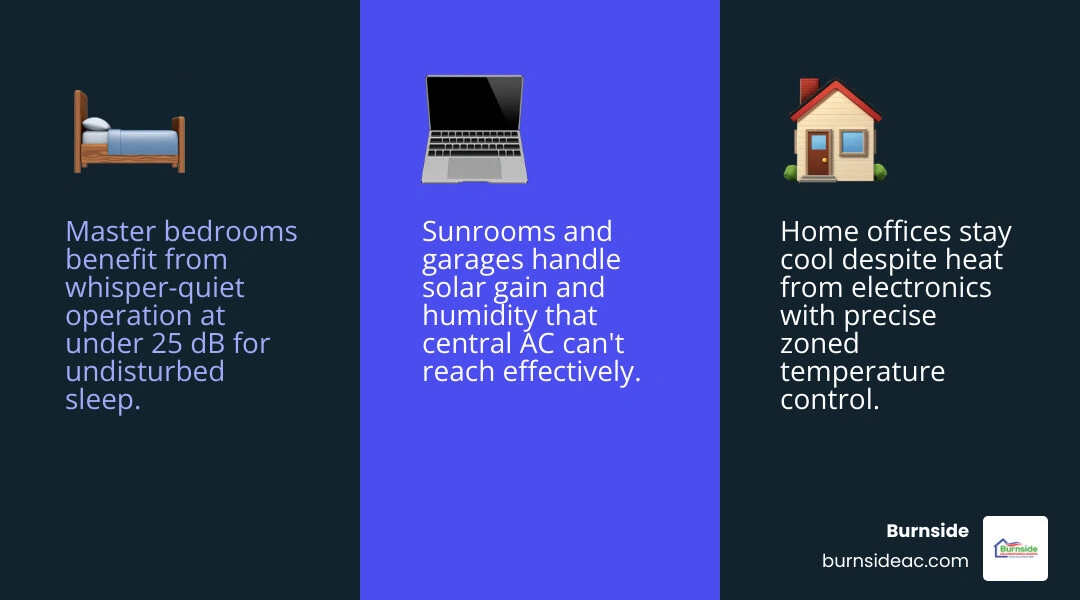
Basic best rooms for a mini split system terms:
The Best Rooms for a Mini Split System to Solve Comfort Gaps
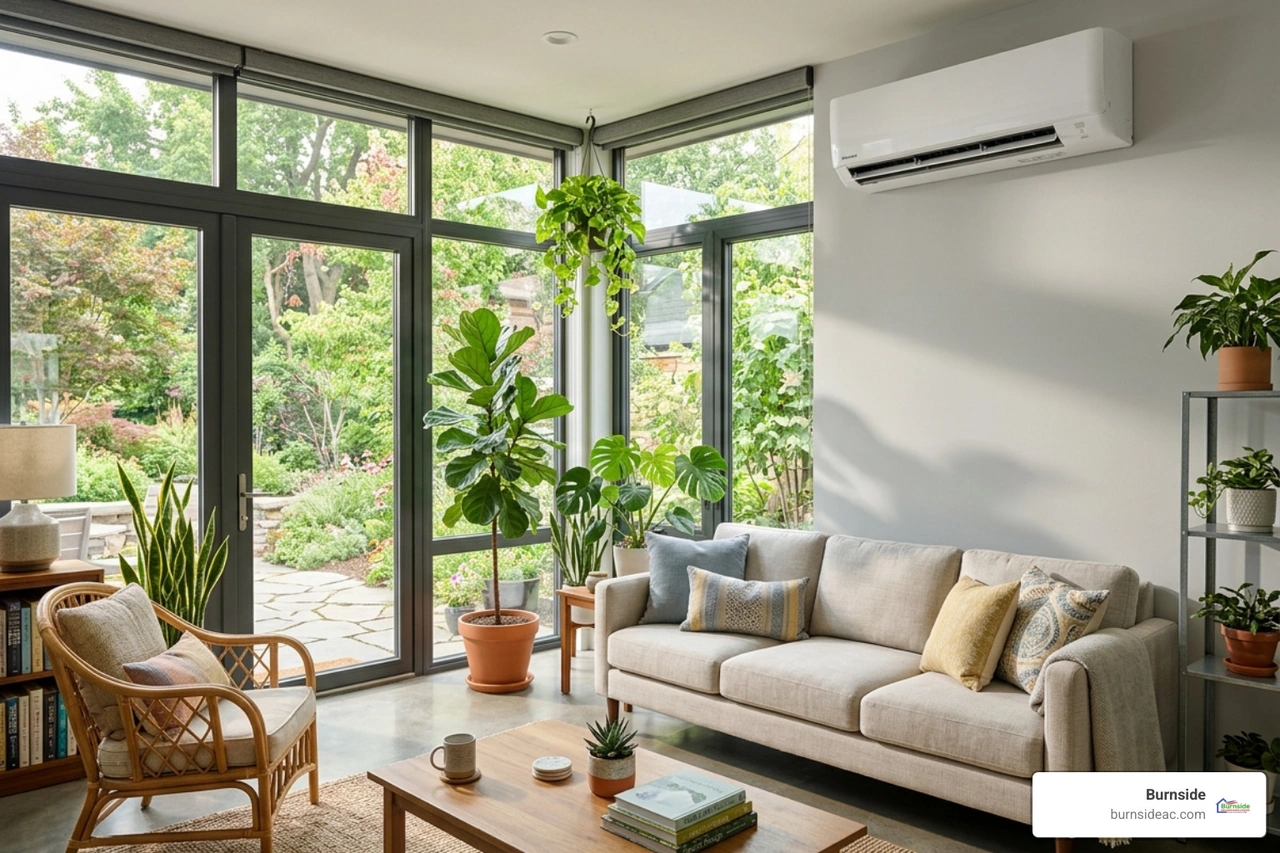
In our decades of serving North Texas, we’ve found that most homes have at least one room that just won't stay comfortable. These "comfort gaps" are the primary reason homeowners look for Ductless Mini Split Systems Complete Guide resources. Whether it’s a room addition in Melissa or a master suite in Prosper, certain areas are simply better suited for ductless technology than a standard central air upgrade.
The best rooms for a mini split system are often those that sit at the far end of a duct run or are separated from the rest of the house by a flight of stairs. When we install these systems, we aren't just adding a heater or cooler; we are creating a dedicated comfort zone. This allows you to keep the guest room in Celina at a conservative temperature while keeping your home office at a crisp 70°F for maximum productivity.
Why Bedrooms are the Best Rooms for a Mini Split System
If there is one room where a mini split truly shines, it’s the bedroom. Achieving high-quality sleep requires consistent temperature control for roughly eight hours. Central systems often cycle on and off, leading to 3- to 5-degree swings that can wake you up.
Ductless units provide a "whisper-quiet" experience. Operating at noise levels often below 25 dB, these units are practically silent compared to the loud "thump" of a central furnace or the rattling of a window unit. For parents in McKinney, this makes them the ideal choice for nurseries, ensuring the baby isn't disturbed by the HVAC system. Furthermore, Ductless Mini Splits Mckinney Home owners often find that the precise modulation of these units eliminates the "sauna-to-icebox" cycle common in older homes.
Transforming Garages and Sunrooms into Year-Round Living Areas
In North Texas, we love our outdoor spaces, but the heat often renders them useless for four months of the year. Sunrooms, in particular, face massive solar gain. Even the best central AC can struggle when the afternoon sun hits those floor-to-ceiling windows. A dedicated mini split can handle that specific heat load without forcing the rest of your house to become a freezer.
Garages are another "final frontier" for home comfort. Whether you’re setting up a home gym in Frisco or a woodworking workshop in Anna, an unconditioned garage can reach 100°F+ easily. A mini split effectively turns these spaces into year-round living areas. However, we always recommend checking your insulation first—adding a unit to a garage with a thin, uninsulated door is like trying to cool a sieve. When you compare a Mini Split vs Window Unit Comparison, the mini split wins on efficiency and security every time.
Strategic Placement: Height, Walls, and Airflow Rules
Once you’ve identified the best rooms for a mini split system, the next step is figuring out exactly where to mount it. Placement is just as important as sizing. If you put a high-quality unit in the wrong spot, you’ll end up with "air starvation" or uneven cooling.
The golden rule for indoor units is a mounting height between 6 and 8 feet. This allows the cool air—which is naturally heavier than warm air—to descend gracefully into the room, creating an even blanket of comfort. You also need to maintain at least 6 inches of clearance between the top of the unit and the ceiling. Since mini splits pull air in from the top, mounting them flush against the ceiling can lead to a 30% drop in efficiency. For more on the technical side, check out our Mini Split service page.
Interior vs. Exterior Wall Installation
This is one of the most common questions we get in McKinney and Plano.
- Exterior Walls: These are generally the "best" choice. They allow for natural gravity drainage of the condensate (the water the unit pulls out of the air). The refrigerant lines and drain hose can go straight through a 3-inch hole to the outside.
- Interior Walls: These are possible but more complex. Because water won't flow uphill, an interior wall installation often requires a small condensate pump to push the water to the nearest drain. This can add a slight hum to the system and increases the chance of maintenance needs later.
We always weigh the The Pros and Cons of Mini Split HVAC Systems with our customers, looking at both the aesthetic impact and the long-term reliability of the drainage setup.
Avoiding the "Ghost Trap" and Other Placement Mistakes
There are a few places where a mini split just doesn't belong.
- Hallways: Many people think putting a large unit in a hallway will cool all the adjacent bedrooms. This is a myth we call the "Ghost Trap." Cold air is heavy; it will sink to the hallway floor and stay there, leaving the bedrooms sweltering while the hallway is 60°F.
- Above TVs or Electronics: High-end computers and TVs emit heat. This heat can trick the mini split’s sensors into thinking the room is hotter than it actually is, causing it to overwork. Plus, in the rare event of a leak, you don't want water dripping onto your 80-inch screen.
- Kitchens: While it’s tempting to cool a hot kitchen, grease and oil from cooking can quickly clog the fine filters of a ductless head. If you must put one in a kitchen, keep it at least 3 feet away from the cooking surface.
When comparing a Central AC vs Ductless Mini Split Comparison, the mini split relies on localized sensors, so keep it away from direct sunlight and heat-emitting lamps.
Sizing Your System for Maximum Efficiency
Getting the BTU (British Thermal Unit) count right is critical. If a unit is too small, it will run constantly and never reach the set temperature. If it’s too large, it will "short cycle," turning on and off so quickly that it never has a chance to dehumidify the air, leaving your room feeling clammy.
| Room Size (sq. ft.) | Recommended BTU | Ideal Room Type |
|---|---|---|
| 100 – 250 | 6,000 BTU | Nursery, Small Office, Guest Bath |
| 250 – 400 | 9,000 BTU | Standard Bedroom, Medium Office |
| 400 – 650 | 12,000 BTU | Master Suite, Small Living Area |
| 650 – 1,000 | 18,000+ BTU | Large Living Room, Open Concept Area |
While these rules of thumb are helpful, we always perform a Manual J load calculation to account for your home's specific insulation, window quality, and North Texas sun exposure. In many cases, Mini Split Zoning in Mckinney homes is the best approach, using one outdoor condenser to power multiple indoor heads for different rooms.
Outdoor Unit Considerations for Longevity
The outdoor portion of your system—the condenser—needs some love, too. To keep it running efficiently through a Princeton or Allen summer, it needs room to breathe. We recommend 1 to 3 feet of clearance on all sides. Avoid tucking it behind dense shrubbery or under a deck where heat can get trapped.
Ideally, the outdoor unit should be placed in a shaded area. If the unit is baking in the direct afternoon sun, it has to work much harder to shed heat, which reduces its lifespan. We always mount these on stable, level pads to prevent vibration and ensure the refrigerant flows correctly. For residents in the area, a professional Ductless AC System Mckinney TX installation ensures that the outdoor unit is positioned for maximum performance.
Frequently Asked Questions about Best Rooms for a Mini Split System
Can I install a mini split in a kitchen?
Technically, yes, but proceed with caution. The heat from ovens and stovetops can interfere with the unit's temperature sensors. More importantly, airborne grease can coat the internal components, making the unit difficult to clean and reducing its efficiency. If the kitchen is part of a large open-concept area, we recommend placing the unit in the dining or living area nearby rather than directly over the stove.
Is a hallway a good location for a ductless head?
Generally, no. As mentioned with the "Ghost Trap" phenomenon, hallways are transition spaces. A unit in a hallway will satisfy its thermostat quickly because the space is small, but it won't push enough air through doorways to cool the actual bedrooms. It is almost always better to have smaller, dedicated units in each room.
How high should the indoor unit be mounted?
The "sweet spot" is 7 feet from the floor. You want it high enough that the air can disperse before it hits people (avoiding uncomfortable drafts), but low enough that you can still reach it with a step stool to clean the filters every month or two. Never go higher than 10 feet, as the air may not reach the floor effectively.
Conclusion: Trust the McKinney Comfort Experts
Choosing the best rooms for a mini split system is the first step toward reclaiming your home's comfort. Whether you’re trying to fix a "sauna" bedroom in Prosper or finally turn that garage in Melissa into a usable gym, strategic placement and professional sizing are the keys to success.
At Burnside Air Conditioning & Heating, we’ve been serving the McKinney and Collin County community since 1958. We are family-owned and operated, and we take pride in our "Gold Star Standard" of service. We prioritize American-made parts and ensure every installation is handled with the precision that North Texas homes require.
If you’re ready to bridge the comfort gaps in your home, we’re here to help with expert Ductless Mini Split Mckinney TX solutions. Give us a call today, and let’s find the perfect spot for your new system!
Other Blog Posts
Latest Blogs

Customer Testimonial
Hear What Our Customers Say About Their Burnside Experience


I usually don’t leave reviews but Burnside AC really impressed me both times I’ve used them. They were honest and affordable, and they worked around my schedule without any problem. Every technician I met was pleasant, professional, and willing to go above and beyond to make sure everything was done right. It’s rare to find a company you can truly trust, and I highly recommend them.
Jason was excellent. Extremely knowledgeable and very professional. I am really happy with the service he provided, as well as conversing with him personally. I highly recommend him and Burnside. Will definitely be referring Jason and Burnside to family and friends in need of service. Thanks again, Jason!
Thank you Burnside for your great customer service and excellent maintenance team! H.B. completed our fall checkup today in a timely manner and was very friendly and professional. Appreciate you all!
"We have used Burnside for nearly 30 years. They have always been prompt, polite, and professional. Our latest request was a disconnect. You can be sure Burnside's phone will ring as soon as new service is required!"
"I am so impressed with Burnside!!! I will never even consider using anyone else. I was u def a lot of pressure and the heating system was not working correctly and they found a minor inexpensive solution. Another local vendor charged way more for a similar situation. I immediately sighed up for their annual program. God bless them."
"I had Burnside install a new A/C system a few years ago. They did a great job and have returned on a few occasions to perform maintenance. Their technicians are well trained, knowledgeable and courteous. I would highly recommend them for your A/C and heating needs!"
"This crew who installed both of our HCAC units were very good. They worked hard for over 8 hours so we did not have to worry about getting uncomfortable with both units down. Would recommend Burnside to family and friends."
"Excellent inspection and service by Jacob McCormick. He was very efficient, personable and professional. We would like to request him for our future inspections. A first class job!"
"I cannot praise Tim enough for coming to our rescue! We were having issues with rooms over heating and getting too cold, and he was at our house with quickness to resolve the issue!"
.webp)