
A Practical Guide to Heat Pump Technology
Burnside Air Conditioning, Heating & Plumbing

A heat pump doesn't burn fuel — it moves heat that already exists into or out of your home. Here's heat pump technology explained simply: how it heats in winter, cools in summer, and saves energy all year.
Heat Pump Technology Explained Simply: What Every McKinney Homeowner Should Know
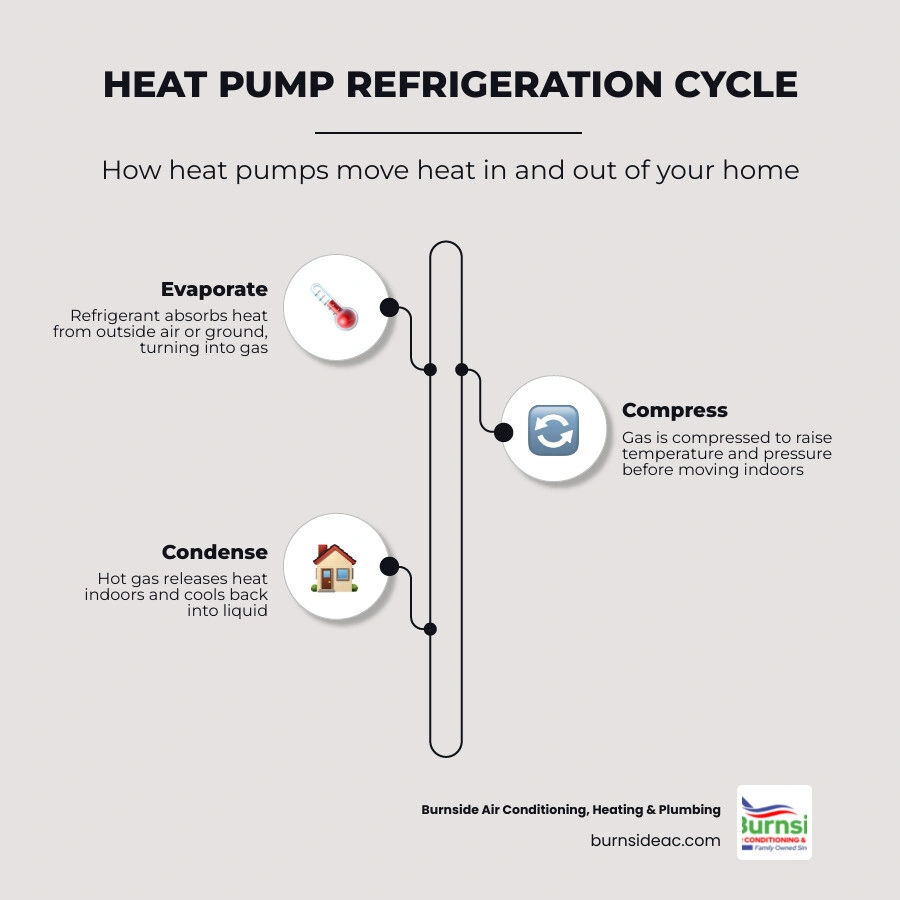
Heat pump technology explained simply comes down to one core idea: instead of burning fuel to create heat, a heat pump moves heat that already exists in the air or ground into your home.
Here is a quick breakdown of how it works:
- What it does: Transfers heat between indoors and outdoors using electricity and refrigerant
- In winter: Pulls heat from outside air (even cold air) and moves it inside to warm your home
- In summer: Reverses the process, pulling heat from inside and releasing it outdoors to cool your home
- Why it's efficient: For every 1 unit of electricity used, a heat pump can deliver 3 to 4 units of heating or cooling energy
- Main types: Air-source, ground-source (geothermal), and ductless mini-split systems
- Best for: Year-round home comfort with lower energy use than traditional furnaces or electric resistance heaters
If you've been hearing more about heat pumps lately, there's a good reason. In 2022, heat pump sales in the United States actually surpassed natural gas furnace sales for the first time — a sign that homeowners across the country are paying attention to this technology. And for homeowners in McKinney, TX and the surrounding North Texas communities, understanding how heat pumps work can help you make smarter decisions about your home comfort system.
This guide walks you through everything you need to know — from the basic refrigeration cycle to the different system types, how they stack up against traditional furnaces, and what maintenance looks like over the life of your system.
Learn more about heat pump technology explained simply:
- are heat pumps energy efficient in mild climates
- are heat pumps good for texas weather
- heat pump benefits for homeowners
What is a Heat Pump and How Does It Work?
To understand how a heat pump works, it is best to start with an appliance you already use every day: your kitchen refrigerator. A refrigerator does not actually create cold air. Instead, it extracts the heat from inside the fridge cabinet and dumps it out into your kitchen. If you have ever felt the warm air blowing from the bottom or back of your refrigerator, you have felt this heat transfer process in action.
A heat pump operates on this exact same thermodynamic principle, but it has a clever trick up its sleeve: it can reverse the direction of the heat transfer.
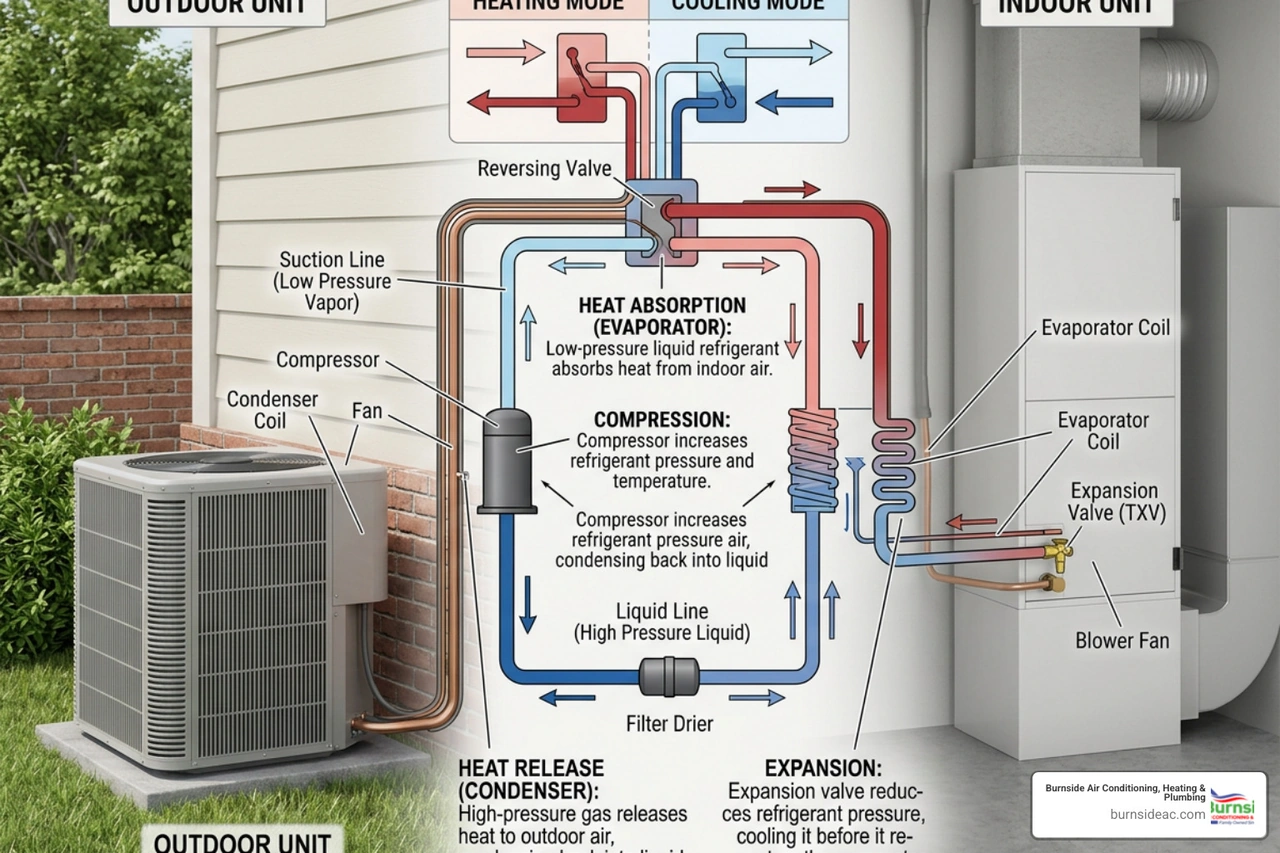
The magic behind this process relies on a closed loop of circulating refrigerant, which is a special chemical fluid that can easily change from a liquid to a gas and back again at very low temperatures. By manipulating the pressure of this refrigerant, the system can control when it absorbs heat and when it releases it.
To see how this works across both seasons, let's explore How a Heat Pump Heats and Cools Your Home by looking at the specific steps in the refrigeration cycle.
Heat Pump Technology Explained Simply: The Heating Cycle
During the winter in McKinney, TX, your heat pump acts as a heat gatherer. Even when the air outside feels chilly to you, there is actually a surprising amount of ambient heat energy present in the atmosphere. In fact, heat energy exists in any air that is warmer than absolute zero (-459.67°F).
Here is how the heating cycle extracts that outdoor warmth and brings it inside:
- Evaporation: The refrigerant starts as a cold liquid flowing through the outdoor unit's evaporator coil. Because the refrigerant is engineered to be much colder than the outdoor air, any heat present in the outdoor air naturally moves toward the colder refrigerant. As the refrigerant absorbs this ambient heat, it warms up and evaporates into a low-pressure gas.
- Compression: This low-pressure gas travels to the compressor in the outdoor unit. Think of the compressor like a bicycle pump. If you have ever pumped up a bicycle tire quickly, you probably noticed the pump cylinder got hot. By compressing the refrigerant gas into a much smaller space, the compressor dramatically raises its pressure and its temperature, turning it into a hot, high-pressure vapor.
- Condensation: The hot gas is pumped indoors to the indoor coil (the condenser). Your home's indoor fan blows air across this hot coil. The heat naturally transfers from the hot refrigerant to the cooler air in your home, warming your living spaces. As the refrigerant loses its heat, it condenses back into a warm, high-pressure liquid.
- Expansion: Finally, the liquid refrigerant passes through an expansion valve, which rapidly lowers its pressure. This sudden drop in pressure causes the refrigerant's temperature to plummet, turning it back into a freezing cold liquid, ready to head back to the outdoor coil to repeat the process.
Heat Pump Technology Explained Simply: The Cooling Cycle
When our intense North Texas summer heat arrives, you do not need a separate air conditioning system. Your heat pump simply uses a component called a reversing valve to flip the flow of the refrigerant.
In cooling mode, the heat pump acts exactly like a standard central air conditioner:
- Indoor Heat Absorption: The indoor coil now acts as the evaporator. The cold liquid refrigerant absorbs the heat from your indoor air, cooling your home and lowering the humidity.
- Compression: The warmed refrigerant gas travels outside to the compressor, where it is compressed to raise its temperature even higher than the outdoor temperature.
- Outdoor Heat Rejection: The hot gas flows through the outdoor coil. Because the refrigerant is now hotter than the outdoor air (even on a 100°F day in Plano or Frisco), the heat naturally transfers from the refrigerant to the outside atmosphere.
- Expansion: The cooled liquid refrigerant passes through the expansion valve, gets extremely cold, and returns indoors to keep your home perfectly comfortable.
Heat Pump Technology Explained Simply: Types of Systems
Not all homes in Collin County are built the same way. Some have extensive ductwork, while others rely on radiant heat or have historic layouts with no space for ducts. Fortunately, heat pump technology is highly adaptable.
| System Type | Primary Heat Source | Best Suited For | Key Advantage |
|---|---|---|---|
| Air-Source Heat Pump | Outdoor Air | Homes with existing ductwork in North Texas | Most common, versatile, and cost-effective to install |
| Ground-Source (Geothermal) | Underground Soil/Water | Large properties, new builds looking for maximum efficiency | Extremely long lifespan and highly consistent performance |
| Ductless Mini-Split | Outdoor Air | Homes without ducts, room additions, zoned cooling | Precise room-by-room temperature control |
When planning a Heat Pump Installation for Your Home, choosing the right system type is the first step toward long-term comfort and efficiency.
Air-Source Heat Pumps
Air-source heat pumps are the most common type of system installed in residential neighborhoods throughout McKinney, Allen, and Frisco. These systems transfer heat between your indoor air and the outdoor air.
They are incredibly popular because they can connect directly to your home's existing central ductwork, making them an easy, drop-in replacement for a traditional gas furnace and air conditioner pairing. Because of our relatively mild winters and hot summers, air-source systems are perfectly suited to the North Texas climate, providing highly efficient year-round comfort without the need for major structural modifications to your home.
Ground-Source and Geothermal Systems
While air temperatures fluctuate wildly between January and August, the temperature of the ground just a few feet below the earth's surface remains incredibly constant—usually between 50°F and 60°F year-round. Geothermal heat pumps take advantage of this stability.
These systems use a network of underground pipes (called a ground loop) filled with water or a specialized fluid. In the winter, the fluid absorbs heat from the warm earth and carries it to the heat pump inside. In the summer, the process reverses, and the system deposits heat from your home back into the cool ground. Because they do not have to struggle against freezing winter winds or scorching summer air, geothermal systems are incredibly efficient. Additionally, the indoor components can last up to 24 years, while the underground loops can easily last over 50 years.
Ductless Mini-Split Systems
If your home in Celina or Prosper does not have ductwork, or if you have a newly added sunroom or guest suite that stays too hot in the summer, a ductless mini-split is the perfect solution.
These systems consist of a small outdoor compressor connected to one or more sleek, wall-mounted indoor air handlers via a small bundle of refrigerant lines. Because they do not require bulky ducts, they avoid the energy losses associated with ductwork leaks (which can account for more than 30% of space conditioning energy consumption). Ductless systems also allow for zonal heating and cooling, meaning you can turn off the climate control in unoccupied guest rooms while keeping your master bedroom perfectly chilled.
How Heat Pumps Compare to Traditional Furnaces and Boilers
The fundamental difference between a heat pump and a traditional heating system is how they handle energy. A gas furnace or electric boiler must generate heat. They do this by burning a fossil fuel (like natural gas or propane) or by passing electricity through high-resistance heating coils (similar to a giant toaster).
This process of generating heat is limited by the laws of physics. Even the most advanced, high-efficiency condensing gas furnaces can only achieve about 95% to 98% efficiency, meaning a small portion of the fuel you pay for is lost through the exhaust flue. Electric resistance heaters are technically 100% efficient at converting electricity to heat, but because electricity is often more expensive than natural gas, they can be incredibly costly to run.
Heat pumps, on the other hand, do not generate heat—they simply move it. Because moving heat requires significantly less energy than creating it, heat pumps break through the 100% efficiency barrier. This fundamental difference is why so many homeowners are exploring how Are Heat Pumps Good for Texas Weather to replace older, fuel-burning heating systems.
Efficiency and Coefficient of Performance (COP)
To measure the efficiency of a heat pump, the HVAC industry uses a metric called the Coefficient of Performance (COP).
The COP is a simple ratio: it compares the amount of useful heat energy a system delivers to the amount of electrical energy it consumes to do the work.
- A typical electric space heater has a COP of 1.0 (1 unit of heat out for every 1 unit of electricity in).
- A standard modern heat pump has an average COP of around 3.0 to 4.0.
This means that for every single kilowatt-hour (kWh) of electricity your heat pump consumes, it delivers 3 to 4 kWh worth of heat into your home. In practical terms, this represents up to a 75% reduction in electricity use for heating compared to standard electric resistance systems. These remarkable efficiency levels translate directly into lower monthly utility bills, which is one of the premier Heat Pump Benefits for Homeowners in our region.
Cold Climate Performance
A common myth about heat pumps is that they do not work when the temperature drops below freezing. While this may have been true of early models from the 1970s and 1980s, modern heat pump technology has made massive leaps forward.
Today's cold-climate heat pumps utilize advanced variable-speed compressors (often called inverter technology) and electronic expansion valves. Instead of simply turning completely "on" or "off," a variable-speed compressor can modulate its speed up or down in tiny increments. This allows the system to run continuously at a lower, highly efficient speed, keeping your home's temperature incredibly stable.
When the outdoor temperature drops, the compressor can ramp up its speed to extract heat from freezing air. Many modern systems can operate at high efficiency even when outdoor temperatures drop well below 0°F. For extreme weather events, heat pumps can be paired with a small auxiliary electric heating coil or configured as a "dual-fuel" system alongside an existing gas furnace to ensure your family stays perfectly warm no matter what the Texas winter throws at us.
Maintenance and Lifespan of Your Heat Pump
A high-quality, professionally installed heat pump will typically provide reliable comfort for about 15 years. However, because a heat pump works hard all twelve months of the year—switching from heating duty in January to heavy-duty cooling in July—it undergoes more operational wear and tear than a standalone furnace.
To keep your system running smoothly and protect your investment, keeping up with a regular Heat Pump Maintenance Schedule for Homeowners is absolutely essential.
Signs Your System Needs Professional Attention
Like any mechanical system with moving parts, your heat pump may occasionally need a little extra care. Knowing what to look for can help you catch minor issues before they turn into major system failures.
Keep an eye out for these common Signs Your Heat Pump Needs Repair:
- Weak Airflow: If the air coming from your vents feels weak, it could point to a clogged air filter, a failing blower motor, or a leak in your ductwork.
- Strange Noises: While heat pumps run very quietly, squealing, grinding, or loud rattling noises are clear indicators that a belt, bearing, or fan blade needs attention.
- Short Cycling: If your system is constantly turning on and off in rapid succession, it could be overheating due to restricted airflow, or it might have a refrigerant leak.
- Ice Accumulation: While a light frost on the outdoor coil is normal during winter defrost cycles, a thick buildup of solid ice indicates a malfunction in the defrost control board or low refrigerant levels.
The Importance of Regular Tune-Ups
The single best way to maximize the lifespan of your heat pump and keep your energy bills low is to schedule professional preventative maintenance twice a year: once in the spring before the cooling season, and once in the fall before the heating season.
During a professional tune-up, a qualified technician will perform several critical tasks:
- Clean the Coils: Dirty coils insulate the refrigerant, making it much harder for the system to absorb or release heat. Regular cleaning restores optimal heat transfer.
- Check Refrigerant Levels: Operating a system with too much or too little refrigerant forces the compressor to work harder, accelerating wear and lowering efficiency.
- Inspect Electrical Connections: Tightening loose wire connections and testing capacitors prevents unexpected system breakdowns on the hottest or coldest days of the year.
For a complete look at what our technicians do during these visits, check out our Heat Pump Services Guide and learn why Scheduling Regular Heat Pump Service is the smartest move you can make for your home comfort.
Frequently Asked Questions About Heat Pumps
We know that choosing a new home comfort system can bring up a lot of questions. Here are quick, straightforward answers to some of the most common questions we hear from local homeowners.
Can a heat pump really heat my home when it is freezing outside?
Yes! Modern heat pumps are highly capable of heating your home during freezing weather. Thanks to advanced variable-speed compressors and high-performance refrigerants, these systems can extract ambient heat from the outdoor air even when temperatures drop below freezing. For peace of mind during rare North Texas hard freezes, we can install auxiliary heating elements to make sure your home stays warm and cozy.
How long does a typical residential heat pump system last?
With regular professional maintenance, a high-quality residential heat pump typically lasts about 15 years. Keeping your air filters clean and scheduling twice-yearly professional tune-ups are the best ways to ensure your system reaches its full potential. If your current system is approaching this age and requiring frequent repairs, it may be time to learn When to Consider Home Heat Pump Replacement.
What are the environmental benefits of switching to a heat pump?
Because heat pumps run entirely on electricity and are incredibly efficient, they can dramatically reduce your household's carbon footprint. By moving heat instead of burning fossil fuels like natural gas or heating oil, a heat pump eliminates direct combustion emissions from your home. As our local electrical grids transition to cleaner, renewable energy sources like wind and solar power, operating a heat pump becomes cleaner and more sustainable every single year.
Conclusion
Understanding heat pump technology explained simply helps demystify one of the most efficient, versatile, and environmentally friendly home comfort solutions on the market today. By shifting heat rather than creating it, these systems deliver exceptional year-round comfort while helping you take control of your monthly energy usage.
At Burnside Air Conditioning & Heating, we have been serving our neighbors in McKinney, Frisco, Allen, and the surrounding Collin County communities since 1958. As a family-owned local business, we take immense pride in offering accurate diagnostics, expert solutions, and our signature "Gold Star Standard" of customer service.
If you are ready to explore how a heat pump can transform your home's comfort, we can guide you through the entire process—from choosing the right system size to explaining What to Expect from Heat Pump Installation.
Schedule your McKinney heat pump service today with our friendly team of certified comfort experts!
Need Help?
Contact us today to discuss your needs. Our team is ready to help.
About the Author
Burnside Air Conditioning, Heating & Plumbing
More Articles
View All PostsRelated Articles

How Long Should a Typical Furnace Repair Service Take?
Waking up to a freezing house is stressful enough without guessing when your heat will return. We break down the exact timeline between diagnosing the issue and fixing your furnace.
Read Article
The Impact of Clogged Burners on Furnace Efficiency and Safety
Rust and debris can silently block your heating system's gas flow, creating hidden hazards. Learn to spot the signs of incomplete combustion early to protect your home.
Read Article
Why Tankless Water Heaters Need Specific Freeze Protection in Texas
Exterior-mounted tankless units are highly vulnerable to sudden Texas cold snaps. Understand the risks to your isolation valves and why professional winterization is the safest choice for your home.
Read Article
Navigating Gas Line Safety Inspections for Furnace Replacements in Prosper, TX
Replacing a failing heating system shouldn't mean drowning in municipal red tape. Discover what to expect during your mandatory town safety inspection.
Read Article
Programmable Thermostat Upgrades: Wi-Fi Connected vs. Local Control Only
Deciding between a high-tech smart thermostat and a reliable standard model can be confusing. We break down the pros and cons so you can confidently choose the right upgrade.
Read Article
Diagnosing a Clicking Sound Before the Furnace Ignites
When you turn on the heat during the first cold snap, rapid clicking from the HVAC closet can be startling. Find out if it's a normal spark igniter or a sign you need repairs.
Read Article
How Short Cycling Damages Your Furnace Blower Over Time
If your heating system constantly shuts down after just a few minutes, it's causing invisible mechanical wear. We break down why these short run cycles threaten your blower motor.
Read Article
Heating Solutions for Historic Homes in Downtown McKinney, TX
Upgrading the heat in your century-old property shouldn't mean tearing down original plaster. Discover non-invasive HVAC options that deliver modern comfort while preserving architectural charm.
Read Article
Tackling October Indoor Air Quality Challenges as Windows Stay Closed
When you shut your windows for the season, indoor VOCs and odors get trapped inside. Transitioning to active HVAC air management is the key to keeping your home fresh.
Read Article
Humidifier Integration: Bypass vs. Fan-Powered Systems for Dry Texas Winters
When Texas winters dry out your home, choosing between a bypass and a fan-powered humidifier is a critical decision. See how your specific HVAC layout dictates the right system.
Read Article
Does My Heat Pump Need a Defrost Cycle Check Before Winter?
Your heat pump has a hidden vulnerability when temperatures plummet. A proactive defrost cycle check in October is the best way to avoid a total freeze-up in January.
Read Article
How We Detect Microscopic Gas Leaks Around Your Furnace Manifold
Winter cold snaps put immense stress on heating systems, causing dangerous pinhole fissures. See why relying on your nose isn't enough and how our tools keep your family safe.
Read ArticleReady to Get Started?
Whether you need a repair, maintenance, or a new installation, our expert team is here to help.