


Guide
Everything You Need to Know About How a Maintenance Plan Extends Equipment Life
Why Understanding How a Maintenance Plan Extends Equipment Life Could Save You Thousands
How a maintenance plan extends equipment life comes down to one core idea: small, consistent care prevents the kind of cumulative damage that turns a $200 tune-up into a $5,000 emergency repair — or an early system replacement.
Here is a quick answer if you want it:
A maintenance plan extends equipment life by:
- Reducing friction and wear on motors, belts, and bearings through regular lubrication and inspections
- Catching failing components like capacitors and refrigerant leaks before they trigger compressor failure
- Keeping coils and filters clean so the system runs at designed efficiency without overworking
- Validating manufacturer warranties through documented professional service visits
- Extending average HVAC lifespan from 5–10 years (neglected) to 20–30 years (well-maintained)
For homeowners in McKinney, TX and across Collin County, this matters more than most people realize. North Texas summers push HVAC systems hard — a system running through 100°F heat waves accumulates roughly 3,300 operating hours per year, the equivalent of driving a car over 200,000 miles annually. Without regular professional attention, that kind of demand accelerates wear on every moving and electrical component in the system.
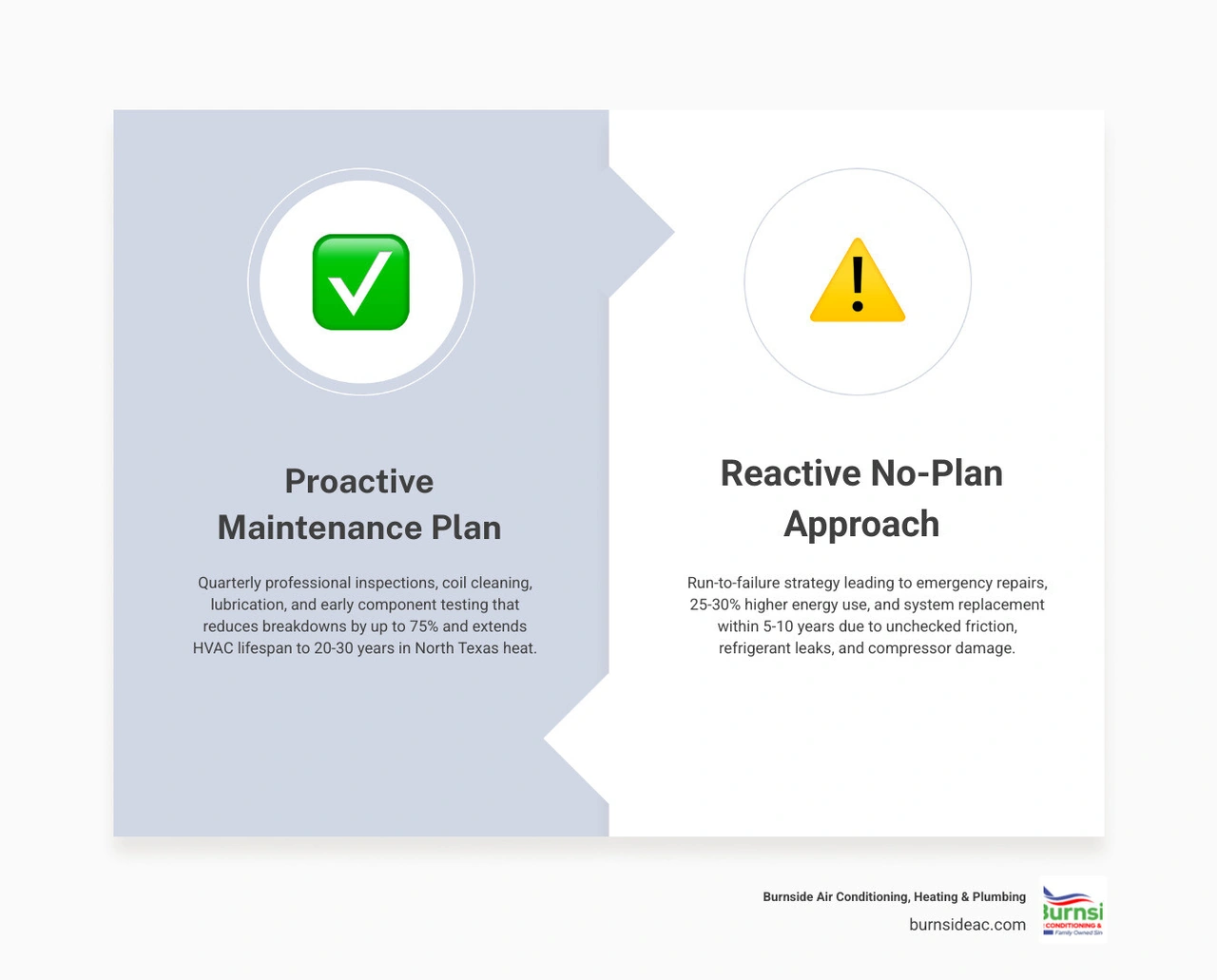
The data backs this up. Preventive maintenance can reduce unplanned breakdowns by up to 75% and cut overall maintenance costs by 25%. A neglected air conditioner can consume 25–30% more energy than a well-maintained one — a cost that quietly compounds on every monthly utility bill.
This guide walks through exactly how and why a structured maintenance plan protects your equipment, what it includes, and how to make sure you have the right approach for your home and climate.
How a maintenance plan extends equipment life vocab explained:
Proactive Care vs. Reactive Repairs: How a Maintenance Plan Extends Equipment Life
To truly appreciate the value of a structured maintenance plan, we have to look at the two primary ways homeowners approach HVAC care: proactive maintenance and reactive (or "run-to-failure") repairs.
Many people view maintenance as an optional luxury. They think, "If the air conditioner is blowing cold air, why should I pay someone to look at it?" This reactive mindset assumes that equipment health is binary—either it works or it is broken.
In reality, mechanical systems degrade on a curve. A run-to-failure approach is actually the most expensive way to manage your home comfort. When you wait for a system to break down before calling for help, you are not just paying for the repair; you are paying for the cumulative collateral damage that occurred leading up to the failure.
To help visualize the difference, let’s compare these two strategies side-by-side:
| Feature / Metric | Proactive Maintenance Plan | Reactive "Run-to-Failure" Approach |
|---|---|---|
| Average System Lifespan | 20 to 30 years | 5 to 10 years |
| Unplanned Breakdowns | Reduced by up to 75% | Frequent, unpredictable, and highly disruptive |
| Operating Efficiency | Retains original factory ratings; lower utility bills | Drops 5% to 10% annually; 25% to 30% higher bills |
| Overall Maintenance Costs | Lowered by up to 25% due to fewer major repairs | 3 to 5 times more expensive per repair event |
| Warranty Status | Fully protected with documented professional service | Frequently voided due to lack of proof of maintenance |
| Emergency Risk | Extremely low; issues caught during mild seasons | High; failures typically occur during peak summer heat |
When a system is neglected, it enters a cycle of deferred maintenance. Industry studies show that deferred maintenance follows a strict 1:4 cost ratio. This means that skipping a routine tune-up eventually costs you four times more in emergency repairs, premature component replacements, and shortened equipment lifespan.
When you skip professional care, you are forcing your system to work under extreme stress. If you want to dive deeper into what happens when a system is left to fend for itself, read our detailed guide on What Happens If You Skip HVAC Maintenance to protect your home from avoidable system failures.

The Science of Wear: How Maintenance Protects Critical Components
Physical assets do not fail without a cause. In North Texas cities like Plano, Frisco, and Celina, our local climate subjects outdoor air conditioning units to intense environmental and mechanical stress. The degradation of an HVAC system is governed by three primary physical enemies: friction, thermal stress, and electrical resistance.
1. Friction and Lubrication Issues
Every rotating part in your air conditioner—from the blower motor bearings to the condenser fan—relies on smooth movement. Over time, factory lubricants break down, dry up, or become contaminated with airborne dust and pollen.
When lubrication fails, metal-on-metal friction takes over. This friction generates localized heat, which further destroys any remaining lubricant. Studies show that up to 40% of preventable bearing failures are caused directly by lubrication issues. Once a bearing begins to seize, it places an enormous physical load on the motor, causing it to draw higher amperage, overheat, and eventually burn out.
2. Thermal Stress and Expansion
Your HVAC system is constantly cycling on and off. This creates rapid temperature fluctuations within the components. For example, when your heat pump or furnace kicks on during a chilly night in Melissa or Prosper, the metal heat exchanger expands. When it shuts off, the metal contracts.
Over thousands of cycles, this constant expansion and contraction causes thermal fatigue. If the system is dirty or has restricted airflow, the temperature swings are far more extreme. This can lead to microscopic cracks in critical parts like the heat exchanger, which not only ruins the equipment but can also pose severe safety hazards like carbon monoxide leaks.
3. Electrical Resistance and Contamination
Dust, humidity, and outdoor debris are excellent insulators—but in the worst way possible. When dust accumulates on electrical terminals, contactors, and control boards, it traps heat. Electrical connections naturally loosen over time due to system vibrations. A loose wire or a dirty contactor increases electrical resistance.
According to electrical engineering data, a loose connection causes localized voltage drops and extreme heat buildup, which can melt wire insulation, damage control boards, and cause complete system failure. Knowing that Regular AC Maintenance Is Essential is the first step toward preventing these silent, invisible system killers from taking offline your home comfort.
How a maintenance plan extends equipment life by preventing component wear
Within your air conditioner, components operate in synergy. If one minor part begins to wear down, it triggers a chain reaction that damages much larger, more expensive parts. Think of it like a row of falling dominoes.
A classic example of this is the dual run capacitor. The capacitor acts like a temporary battery that delivers the electrical boost your compressor and fan motor need to start up and run smoothly. Over time, heat and electrical stress cause capacitors to lose their capacitance (their ability to store an electrical charge).
If a capacitor's strength drops by even 10%, the compressor will struggle to start. It will experience what technicians call "hard starting," drawing massive amounts of electrical current and running at elevated temperatures.
If left unchecked, a weak capacitor will eventually destroy the compressor—the very heart of your air conditioning system. Replacing a capacitor is a quick, straightforward task; replacing a compressor is a major, expensive project that often forces homeowners to replace the entire outdoor unit.
Another common wear item is the fan belt on older or commercial-style systems, or the blower motor assembly on modern variable-speed units. When a belt frays or a blower wheel becomes coated in heavy dust, it creates an unbalanced load. This imbalance causes the motor shaft to wobble, destroying the motor bearings and putting extra strain on the system's electrical controls.
By catching these minor wear items early, our team ensures that a small, easily replaceable component never has the chance to take down a major system asset. To learn more about how you can protect your equipment between professional visits, check out our Ultimate HVAC Maintenance Tips Homeowners guide.
How a maintenance plan extends equipment life through early detection
Early detection is the cornerstone of any successful preventive maintenance plan. Many of the most destructive HVAC problems start out completely silent and invisible to the untrained eye.
Take refrigerant leaks, for instance. A tiny, microscopic pinhole leak in your evaporator coil might only release a fraction of an ounce of refrigerant per month. At first, you won't notice a change in your indoor air temperature. However, as the refrigerant charge slowly drops, the compressor has to work twice as hard and run much longer to cool your home.
Because refrigerant also cools the compressor motor itself, running a system with a low charge causes the compressor to overheat. By the time the system stops cooling entirely, the compressor may have already suffered irreversible thermal damage.
Airflow blockages are another silent hazard. Dust and pet dander gather on the delicate aluminum fins of your indoor evaporator coil, slowly forming an insulating blanket. This dust acts as a barrier, preventing the refrigerant inside the coil from absorbing heat from your home's air.
As a result, the coil’s temperature drops below freezing, causing the condensate moisture on the coil to turn to ice. A frozen coil completely blocks airflow, stops all cooling, and can flood your home with water when it finally melts.
During a scheduled inspection, we use specialized diagnostic tools to measure subcooling, superheat, and static pressure. These measurements allow us to spot tiny refrigerant leaks, airflow restrictions, and sensor calibration errors long before they can cause a system breakdown. For a comprehensive overview of how these diagnostic steps keep your system running, read our HVAC Maintenance Plans Complete Guide.
Core Components of an Effective HVAC Maintenance Plan
An effective maintenance plan is not a quick, five-minute visual check. It is a highly technical, systematic process designed to restore your equipment to its optimal operating specifications.
When our experienced, licensed technicians perform a maintenance visit under our "Gold Star Standard" in McKinney, Allen, or Frisco, they execute a comprehensive checklist:
1. Deep Coil Cleaning
Your outdoor condenser coil and indoor evaporator coil are responsible for the vital heat transfer process. In North Texas, outdoor coils quickly become caked with clay dust, lawn clippings, cottonwood seeds, and pollen.
We wash and clear these coils using specialized, self-rinsing cleaners that dissolve dirt without damaging the delicate aluminum fins. Clean coils allow heat to escape easily, lowering the workload on your compressor.
2. Condensate Drain Line Clearing
As your air conditioner cools your home, it removes gallons of moisture from the air. This water collects in a drain pan and flows out through a condensate line. Over time, algae, mold, and dust can form a thick clog in this line.
We flush the drain lines, clear out any biological buildup, and test safety float switches. If a clog occurs, these safety switches instantly shut off the system, preventing water from overflowing and damaging your ceilings, walls, and floors.
3. Electrical System Testing and Tightening
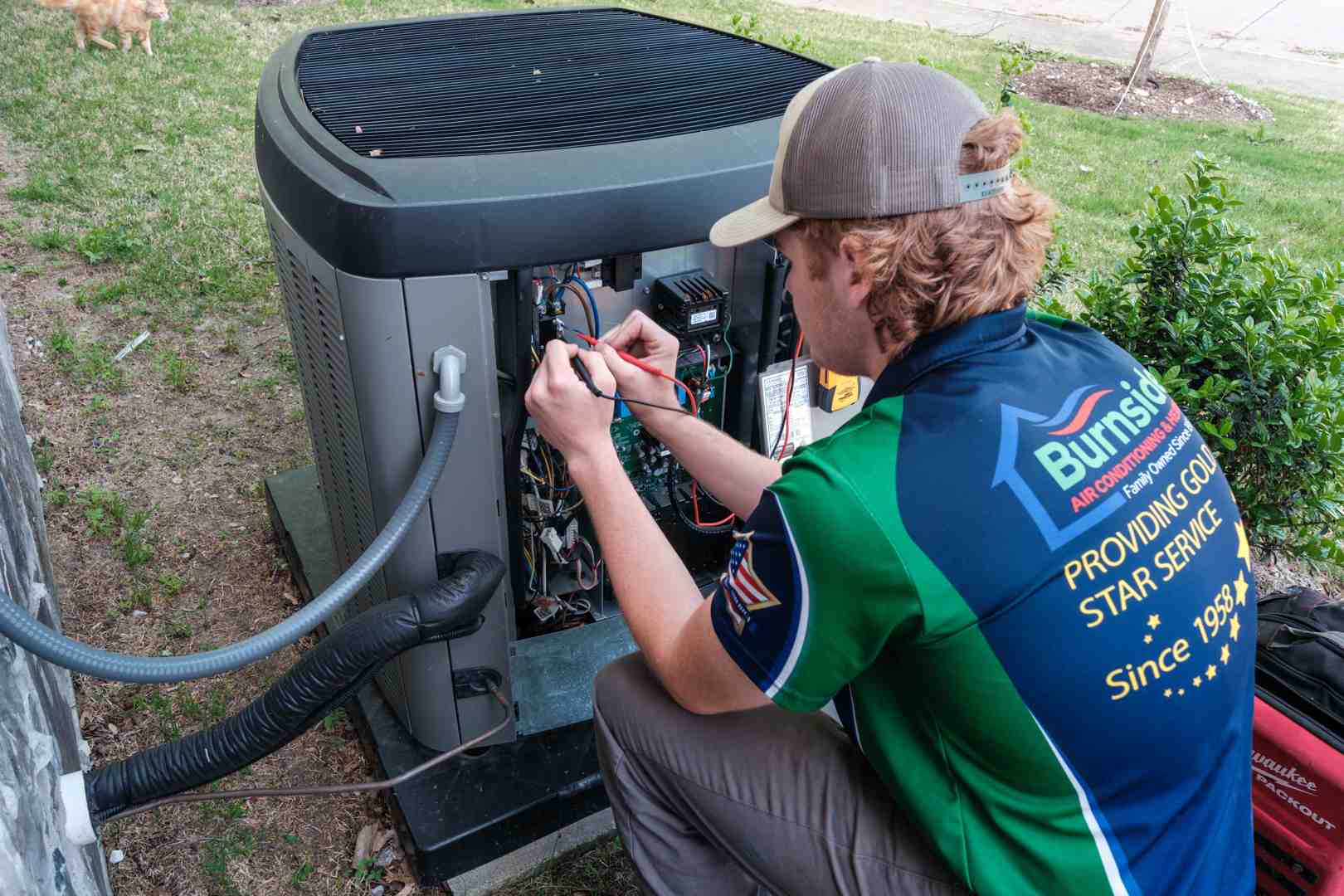
Vibrations from normal operation can loosen electrical connections over time. We inspect all wiring harness connections, tighten terminal screws, and measure the electrical current (amperage) and voltage on key components.
We also test contactors for pitting or burn marks, ensuring clean electrical pathways that prevent motors from running on low voltage.
4. Thermostat and Sensor Calibration
A thermostat that is out of calibration can cause your system to run too long or cycle on and off too rapidly (short cycling). We verify that your thermostat is reading the indoor temperature accurately and that safety sensors—such as limit switches in your heating system—are functioning perfectly.
5. Airflow and Blower Assembly Verification
We inspect the blower motor and wheel, measure static pressure across your air filter, and check duct connections for obvious leaks. Ensuring unrestricted, balanced airflow is critical to keeping utility bills low and preventing premature motor wear.
Participating in a structured program is the easiest way to automate this essential care. Discover how you can gain peace of mind and priority service by reading about how to Commit to Your Home Using an HVAC Membership.
Scheduling Strategies and Triggers for North Texas Climates
When it comes to scheduling your HVAC maintenance, timing is everything. In Collin County, our weather is highly dynamic. We experience freezing winter nights, mild spring and autumn weeks, and punishing, humid summer days where temperatures routinely cross 100°F.
Because of this unique climate profile, a seasonal, calendar-based scheduling strategy is the most practical and effective approach for residential HVAC systems.

We recommend scheduling professional maintenance twice a year:
- Spring Tune-Up (Cooling Focus): This should be scheduled between March and May, before the intense summer heat arrives. The focus is on preparing your air conditioner to handle the long, hot days ahead by verifying refrigerant levels, cleaning condenser coils, and testing capacitors.
- Fall Tune-Up (Heating Focus): This should be scheduled between September and November, before the first winter freeze. The focus shifts to safety and reliability, ensuring your furnace or heat pump is ready to keep you warm without carbon monoxide risks or sudden heating failures.
For heat pumps, which run year-round to provide both heating and cooling, these biannual visits are absolutely critical. Because they never get a season off, they accumulate wear twice as fast as stand-alone systems.
By aligning your maintenance with these natural seasonal transitions, you ensure your equipment is always optimized for the upcoming weather. For a detailed breakdown of timing and frequency based on your specific system type, consult our guide on How Often Should You Service Your HVAC System.
Frequently Asked Questions About HVAC Longevity
Does regular maintenance really lower my monthly utility bills?
Yes, absolutely. When an HVAC system is neglected, dust accumulates on the coils, filters clog, and moving parts lose lubrication. This forces the system to work much harder to move air and transfer heat.
According to energy studies, a neglected air conditioner or heat pump can easily consume 25% to 30% more energy than a clean, well-maintained system.
By keeping coils clean, electrical connections tight, and moving parts lubricated, a maintenance plan keeps your system operating at its peak designed efficiency, which directly lowers your monthly energy consumption. To see how these savings add up over time, read our article on how Regular AC Maintenance Save Money.
Can skipping professional maintenance void my manufacturer warranty?
Yes. Almost all major HVAC manufacturers (including Daikin, Carrier, and Lennox) require proof of regular, professional maintenance to keep your parts warranty valid.
If a major component like your compressor or heat exchanger fails within the warranty period (typically 5 to 10 years), the manufacturer will often ask for documented service records before approving the replacement part.
If you cannot provide proof of annual professional maintenance, your claim can be denied, leaving you to pay for a very expensive replacement out of pocket. Keeping a clean paper trail of professional maintenance is essential to protecting this valuable coverage.
What are the most common warning signs that my system needs immediate attention?
While a maintenance plan is designed to prevent unexpected breakdowns, it is important to know the warning signs that your system needs professional attention between visits.
Keep an eye out for these common red flags:
- Short Cycling: If your system turns on and off every few minutes without cooling or heating your home completely, it is experiencing severe operational stress.
- Unusual Noises: Screeching, rattling, banging, or clicking sounds indicate loose components, failing bearings, or electrical issues that require immediate investigation.
- Poor or Weak Airflow: If you notice some rooms are much warmer than others or if the air coming out of your vents feels weak, you may have a clogged filter, a failing blower motor, or duct issues.
- Unexplained Energy Spikes: If your utility bills jump significantly without a corresponding change in the outdoor temperature, your system is working overtime to compensate for an internal problem.
Conclusion
At Burnside Air Conditioning & Heating, we have been keeping families comfortable across McKinney, Frisco, Allen, Plano, and Collin County since 1958. As a family-owned local business, we know exactly what North Texas weather demands of your home's comfort systems. We build our services around accurate diagnostics, long-term reliability, and a commitment to using high-quality, American-made parts.
Investing in a structured maintenance plan is the single most effective action you can take to protect your home comfort, lower your monthly bills, and ensure your HVAC system lasts for decades rather than failing early.
Don't wait for the next heat wave to test your system's limits. Protect your home and your investment today by exploring our custom Membership Plan options, or contact our friendly team to schedule your seasonal tune-up.
Other Blog Posts
Latest Blogs

Customer Testimonial
Hear What Our Customers Say About Their Burnside Experience


I usually don’t leave reviews but Burnside AC really impressed me both times I’ve used them. They were honest and affordable, and they worked around my schedule without any problem. Every technician I met was pleasant, professional, and willing to go above and beyond to make sure everything was done right. It’s rare to find a company you can truly trust, and I highly recommend them.
Jason was excellent. Extremely knowledgeable and very professional. I am really happy with the service he provided, as well as conversing with him personally. I highly recommend him and Burnside. Will definitely be referring Jason and Burnside to family and friends in need of service. Thanks again, Jason!
Thank you Burnside for your great customer service and excellent maintenance team! H.B. completed our fall checkup today in a timely manner and was very friendly and professional. Appreciate you all!
"We have used Burnside for nearly 30 years. They have always been prompt, polite, and professional. Our latest request was a disconnect. You can be sure Burnside's phone will ring as soon as new service is required!"
"I am so impressed with Burnside!!! I will never even consider using anyone else. I was u def a lot of pressure and the heating system was not working correctly and they found a minor inexpensive solution. Another local vendor charged way more for a similar situation. I immediately sighed up for their annual program. God bless them."
"I had Burnside install a new A/C system a few years ago. They did a great job and have returned on a few occasions to perform maintenance. Their technicians are well trained, knowledgeable and courteous. I would highly recommend them for your A/C and heating needs!"
"This crew who installed both of our HCAC units were very good. They worked hard for over 8 hours so we did not have to worry about getting uncomfortable with both units down. Would recommend Burnside to family and friends."
"Excellent inspection and service by Jacob McCormick. He was very efficient, personable and professional. We would like to request him for our future inspections. A first class job!"
"I cannot praise Tim enough for coming to our rescue! We were having issues with rooms over heating and getting too cold, and he was at our house with quickness to resolve the issue!"
.webp)