
A Quick Start Guide to Choosing the Right Water Heater
Burnside Air Conditioning, Heating & Plumbing

Water heating is nearly 18% of your home's energy use, so the right unit matters. This quick-start guide walks you through fuel type, tank vs. tankless, sizing, and efficiency so you can choose with confidence.
Why Choosing the Right Water Heater Matters for Your Home
Knowing how to choose the right water heater can mean the difference between years of reliable hot water and a costly mistake that drains your energy budget every month. Water heating accounts for roughly 18% of a typical household's energy use — making it one of the biggest utility expenses you have. Yet most homeowners only think about it when something goes wrong.
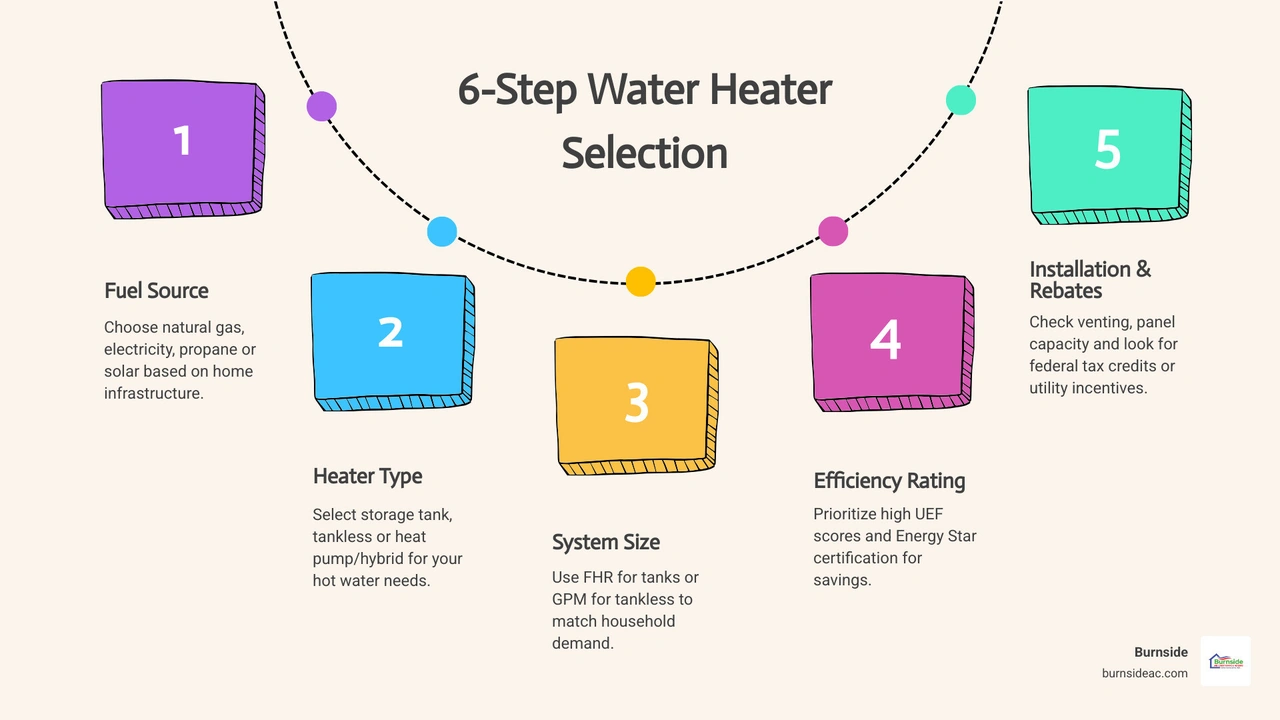
Here's a quick summary to help you choose:
- Identify your fuel source - natural gas, electricity, or propane
- Pick a heater type - storage tank, tankless, or heat pump/hybrid
- Size it correctly - use First-Hour Rating (FHR) for tanks, GPM for tankless
- Check efficiency ratings - look for a high UEF score and Energy Star certification
- Factor in installation needs - venting, electrical panel capacity, and space
- Look for rebates - utility incentives can offset upfront costs
The best time to make this decision is before your current unit fails — not while standing in a cold shower. A rushed, emergency purchase rarely leads to the most efficient or cost-effective choice. Taking a few minutes now to understand your options saves real money over the 10 to 15 years your next water heater will be running.
Key Factors on How to Choose the Right Water Heater
When evaluating your options, the foundation of your decision rests on two main pillars: your home's existing utility infrastructure and the efficiency ratings of the new appliance.
Fuel Types
The fuel source available in your home dictates your options and heavily influences long-term operational costs. In North Texas communities like McKinney, Frisco, and Plano, homes are typically set up for one of three primary fuel sources:
- Natural Gas: Widely available in established suburban neighborhoods. Gas models heat water incredibly fast and generally cost less to operate month-to-month compared to traditional electric resistance models.
- Electricity: Found in almost every home. Electric water heaters are highly adaptable, require no venting, and are the sole option for all-electric neighborhoods.
- Propane: More common in rural or semi-rural properties around Melissa, Celina, and Anna where natural gas lines do not extend. Propane offers the fast recovery benefits of gas but requires a dedicated on-site storage tank.
- Solar Energy: While Texas has abundant sunshine, solar thermal systems are highly specialized and usually require a conventional electric or gas backup heater to ensure reliability during cloudy periods.
For a deep dive into how these two primary utilities stack up against each other, check out our Gas vs Electric Water Heater Complete Guide.
Energy Efficiency and UEF Ratings
To compare the efficiency of different models, look at the Uniform Energy Factor (UEF). This is the industry-standard metric that replaced the old Energy Factor (EF) rating. The higher the UEF number, the more efficiently the unit converts fuel into hot water.
When shopping, prioritize Energy Star certified models. For example, an Energy Star certified heat pump water heater can use up to 70% less energy than a standard electric resistance tank model. Over a 10-year period, opting for a standard electric tank over a hybrid heat pump model can cost you thousands of dollars more in wasted electricity.
Comparing Water Heater Types and Technologies
Different hot water technologies offer distinct performance profiles. Understanding how they handle daily household demand is key to making the right choice.
| System Type | Average Lifespan | Efficiency (UEF) | Key Advantage | Space Requirement |
|---|---|---|---|---|
| Standard Storage Tank | 8–12 Years | 0.63 – 0.95 | Low upfront cost; simple installation | Large floor footprint |
| Tankless (On-Demand) | 20+ Years | 0.82 – 0.98 | Endless hot water; space-saving | Minimal (wall-mounted) |
| Heat Pump (Hybrid) | 10–15 Years | 3.30 – 4.10 | Lowest operating costs | Large room (needs airflow) |
| Condensing Gas | 10–15 Years | 0.80 – 0.90 | Ultra-fast recovery for high demand | Moderate footprint |
How to Choose the Right Water Heater: Tank vs. Tankless
The classic debate for most homeowners in Collin County is choosing between a traditional storage tank and a modern tankless system.
- Storage Tank Water Heaters: These systems maintain a continuous reservoir of hot water (typically 40 to 80 gallons) in an insulated tank. They are reliable and have a lower upfront installation cost. However, they constantly lose energy keeping that water warm even when you are asleep or at work—a phenomenon known as standby heat loss.
- Tankless On-Demand Heaters: These systems eliminate the tank entirely. Instead, they use powerful gas burners or electric heating elements to heat cold water instantly as it flows through the unit. You receive a continuous supply of hot water that never runs out. Additionally, because they only heat water when a tap is turned on, they are up to 30% more energy-efficient than storage tanks.
To see which system fits your daily routine best, read our comprehensive Tankless vs Tank Water Heater Comparison and learn more about the science behind them in our guide on How Does a Tankless Water Heater Work.
Heat Pump and Hybrid Systems
Heat pump water heaters—often called hybrid systems—are the efficiency champions of 2026. Instead of directly generating heat through electric resistance elements, they work like a refrigerator in reverse. They pull heat out of the surrounding air and transfer it into the water tank.
Because they move heat rather than create it, they are incredibly efficient, often achieving efficiencies of 300% to 400% (UEF ratings of 3.3 to 4.1).
Air Volume and Dehumidification
Because hybrid systems rely on the surrounding air, they have unique installation requirements:
- They need to be installed in a space with at least 1,000 cubic feet of surrounding air (roughly a 10' x 12' room) or be properly ducted.
- They naturally cool and dehumidify the air around them. This is an excellent side benefit for warm, damp utility rooms or garages in North Texas, but it means they should not be tucked away in tiny, unventilated closets.
If you are considering upgrading your home's system, explore our professional solutions for Water Heaters.
Condensing and Solar Options
For homes with high hot water demands and natural gas connections, condensing gas water heaters represent an excellent high-efficiency choice. Unlike standard gas heaters that let hot exhaust gases escape through a flue, condensing models capture these hot gases and route them through a secondary heat exchanger. This preheats the incoming cold water, boosting efficiency to UEF ratings between 0.80 and 0.90.
Solar thermal systems use roof-mounted collectors to absorb solar energy and heat a fluid, which then passes through a heat exchanger to warm your domestic water supply. While environmentally friendly, solar systems in North Texas always require a backup gas or electric heating element to ensure you have hot water during extended winter storms or heavy cloud cover.
Sizing Your System for Household Demand
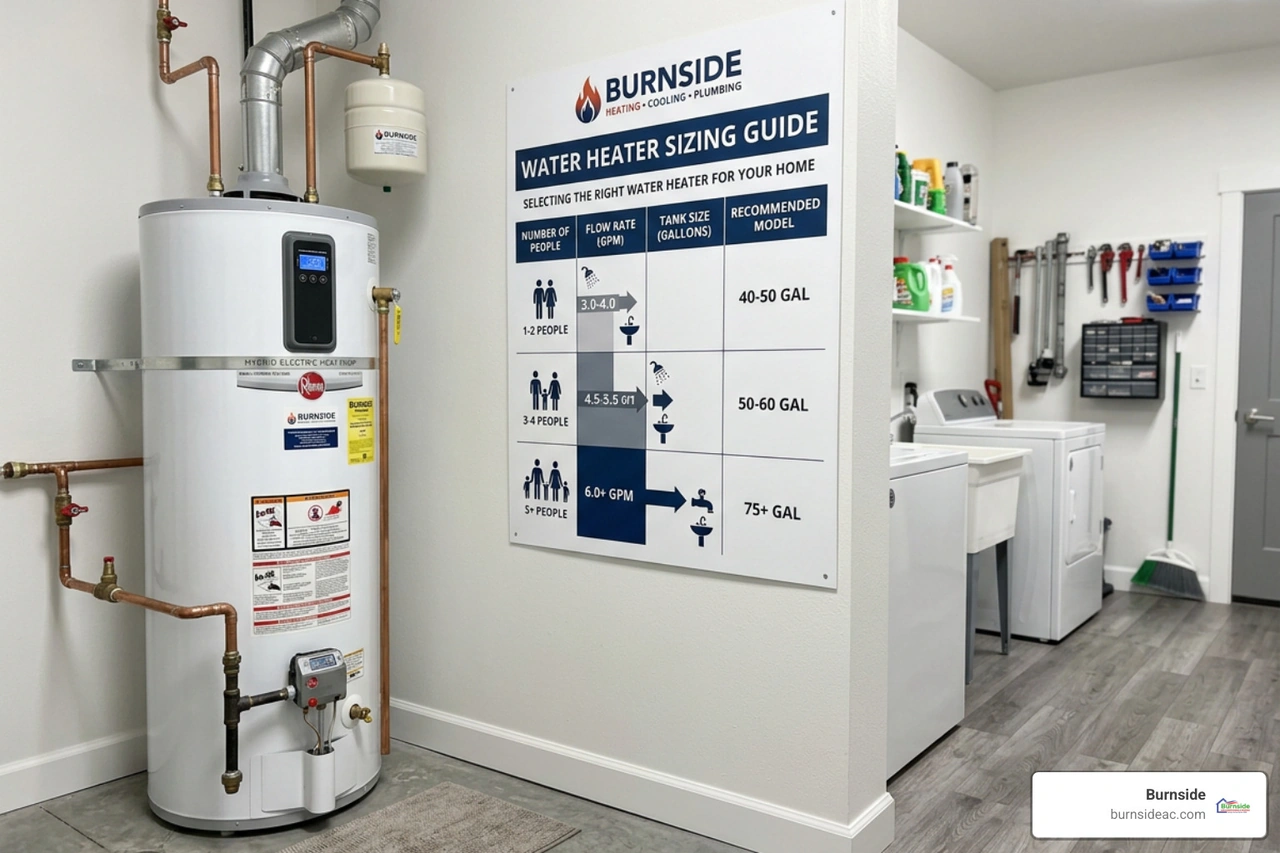
Sizing is the most critical step in learning how to choose the right water heater. An undersized unit leads to cold showers, while an oversized unit wastes energy and costs more to purchase.
How to Choose the Right Water Heater Size for Your Family
For storage tank systems, do not make the mistake of choosing a unit based solely on the tank's physical gallon capacity. Instead, you must look at the First-Hour Rating (FHR) found on the top-left corner of the yellow EnergyGuide label.
The FHR measures how many gallons of hot water the heater can reliably deliver in a single hour of peak usage, starting with a fully heated tank. To estimate your peak-hour demand, use this simple worksheet:
- Shower: 10–20 gallons (at ~2 GPM)
- Dishwasher: 6 gallons per load
- Washing Machine: 15–20 gallons per hot wash cycle
- Shaving/Sink Use: 2 gallons
If your family typically runs a load of laundry, runs the dishwasher, and has two people shower simultaneously in the morning, your peak demand might be around 50 to 60 gallons. You will need a water heater with an FHR that meets or exceeds this number.
Pro Tip: Installing a mixing valve allows you to safely store water in your tank at a higher temperature (which kills bacteria) and automatically mixes it with cold water as it exits. This effectively increases your usable hot water capacity without requiring a larger physical tank.
Calculating Flow Rates for Tankless Systems
Tankless systems are sized by Gallons Per Minute (GPM) and the required temperature rise. Since they do not store water, you must calculate how many fixtures you might run at the exact same time:
- List simultaneous fixtures: For example, two showers (2.0 GPM each) + one kitchen sink (1.5 GPM) = 5.5 GPM peak demand.
- Calculate temperature rise: This is the difference between your desired hot water temperature (typically 120°F) and the temperature of the cold groundwater entering your home.
In Collin County, our groundwater temperature averages around 60°F to 65°F. To reach a comfortable 120°F, your tankless system must achieve a 55°F to 60°F temperature rise. A tankless unit rated for 7.0 GPM at a 60°F rise would easily handle your household's peak demands.
For local expertise on selecting the perfect tankless configuration for your home, consult our Tankless Water Heaters McKinney TX Guide.
Installation Requirements and Long-Term Maintenance
Upgrading or replacing a water heater involves more than just swapping out a tank. You must evaluate your home's existing infrastructure to determine what modifications may be necessary.
- Venting: Standard gas water heaters use atmospheric venting through a metal pipe. High-efficiency condensing gas units and gas tankless systems produce cooler exhaust and require PVC power-venting, which must be routed through an exterior wall.
- Electrical Panels: Standard electric tank heaters require a dedicated 240-volt, 30-amp circuit. Hybrid heat pump models usually require the same, though some newer 120-volt plug-in models can run on standard household outlets. Electric tankless heaters, however, have massive electrical draws and can require up to four separate 40-amp 240V breakers, often necessitating a costly home electrical panel upgrade.
- Gas Line Sizing: Tankless gas systems require a high volume of fuel instantly. Your existing 1/2-inch gas line may need to be upgraded to a 3/4-inch line to supply the unit safely.
- Thermal Expansion: When water is heated, it expands. In modern closed plumbing systems, this expansion can create dangerous pressure spikes. Installing an expansion tank is vital to absorb this extra volume and protect your pipes. Learn more about how this works in our guide: What is an Expansion Tank for a Water Heater.
Essential Maintenance for Longevity
All water heaters require regular care to perform efficiently and reach their maximum potential lifespan. Neglecting simple maintenance can cut your system's life expectancy in half.
- Annual Flushing: Over time, dissolved minerals in our local water supply settle to the bottom of storage tanks, forming a thick layer of sediment. This sediment acts as a barrier between the heating element and the water, forcing the system to work harder and run longer. Flushing a few gallons from your tank once or twice a year removes this buildup.
- Anode Rod Inspection: Storage tanks contain a sacrificial anode rod. This rod is made of magnesium or aluminum and is designed to corrode first, drawing corrosive elements away from the steel tank walls. Inspecting this rod every 2 to 3 years and replacing it when it wears thin can easily add 5 to 10 years to the life of your tank.
- T&P Valve Testing: Test your Temperature and Pressure (T&P) relief valve annually by lifting the lever briefly to ensure water flows out and stops cleanly. This safety valve prevents the tank from over-pressurizing.
- Tankless Descaling: Tankless systems do not suffer from tank corrosion, but their narrow heat exchanger coils can quickly become clogged with scale in hard water areas. Running a vinegar descaling solution through the unit annually is critical to maintaining proper heat transfer.
To understand how proper care keeps your system running strong, read our guide on How Long Does a Water Heater Last.
Fuel Switching and Retrofitting
Switching from an electric tank to a gas model, or converting a standard gas tank to a tankless unit, can offer incredible long-term efficiency benefits. However, fuel switching requires careful planning.
Retrofitting a tankless gas system in place of an old storage tank requires routing new PVC vents, running a larger gas line, and installing a condensate drain line to handle the acidic water produced during combustion. When planning these upgrades, working with experienced local professionals ensures all local building codes and safety standards are met.
For detailed local guidance on making the switch, check out our regional resources:
Frequently Asked Questions about Water Heaters
What are the signs that my water heater is failing?
The average tank water heater lasts between 8 and 12 years. As your system nears the end of its reliable lifespan, watch for these common warning signs:
- Rusty or Discolored Water: If red or brown water comes out of your hot water taps, it indicates the interior steel lining of your tank has begun to rust through.
- Rumbling or Popping Noises: Loud popping or rumbling sounds coming from the unit are caused by boiling water pockets trapped beneath a thick layer of hardened sediment at the bottom of the tank.
- Slow Leaks: Water pooling around the base of the heater or dripping from the connections is a critical warning sign that the tank's inner shell has fractured.
- Inconsistent Temperatures: If your showers are turning cold much faster than they used to, your heating elements or gas burner assembly are likely failing.
If you notice any of these red flags, it is time to schedule a professional assessment. Learn more about your options for Water Heater Repair Installation.
Are there rebates or tax credits for high-efficiency water heaters?
The federal 25C tax credit that previously covered high-efficiency water heaters ended December 31, 2025, and is not available for 2026 installations. However, savings are still out there: many local Texas utility programs offer incentives for upgrading to high-efficiency equipment — for example, homes with Oncor electric delivery may qualify for incentives through Oncor's Home Energy Efficiency Program, paid through participating service providers. Check our rebates and savings page for the programs that are actually available right now, and we'll apply everything you qualify for.
How does hard water affect my water heater?
The municipal water supply in Collin County contains moderate to high levels of dissolved calcium and magnesium, commonly referred to as hard water. When water is heated, these minerals crystallize and precipitate out of the solution, creating a hard crust known as scale.
In standard storage tanks, scale settles on the bottom, insulating the heating elements and causing them to overheat and burn out prematurely. In tankless heaters, scale restricts water flow through the narrow heat exchanger tubes, significantly reducing efficiency and causing the system to shut down to prevent overheating.
Installing a whole-home water softener or a dedicated scale inhibitor system is highly recommended to protect your water heater and ensure it reaches its maximum operating life.
Conclusion
Choosing the right water heater is a major decision that directly impacts your daily comfort and your home's energy bills for the next decade or more. By taking the time to evaluate your fuel source, understand efficiency ratings, and properly size your system based on your household's actual peak demand, you can make a choice that delivers reliable comfort and outstanding energy savings.
Since 1958, Burnside Air Conditioning & Heating & Plumbing has been the family-owned comfort expert trusted by homeowners across McKinney, Frisco, Allen, Melissa, Celina, and Plano. We prioritize accurate diagnostics, expert solutions, and the highest standards of professional service to ensure your home's vital systems operate flawlessly.
Ready to find the perfect hot water solution for your home? Explore our comprehensive options for Water Heaters and let our experienced, local team guide you to the perfect fit.
Need Help?
Contact us today to discuss your needs. Our team is ready to help.
About the Author
Burnside Air Conditioning, Heating & Plumbing
More Articles
View All PostsRelated Articles

How Long Should a Typical Furnace Repair Service Take?
Waking up to a freezing house is stressful enough without guessing when your heat will return. We break down the exact timeline between diagnosing the issue and fixing your furnace.
Read Article
The Impact of Clogged Burners on Furnace Efficiency and Safety
Rust and debris can silently block your heating system's gas flow, creating hidden hazards. Learn to spot the signs of incomplete combustion early to protect your home.
Read Article
Why Tankless Water Heaters Need Specific Freeze Protection in Texas
Exterior-mounted tankless units are highly vulnerable to sudden Texas cold snaps. Understand the risks to your isolation valves and why professional winterization is the safest choice for your home.
Read Article
Navigating Gas Line Safety Inspections for Furnace Replacements in Prosper, TX
Replacing a failing heating system shouldn't mean drowning in municipal red tape. Discover what to expect during your mandatory town safety inspection.
Read Article
Programmable Thermostat Upgrades: Wi-Fi Connected vs. Local Control Only
Deciding between a high-tech smart thermostat and a reliable standard model can be confusing. We break down the pros and cons so you can confidently choose the right upgrade.
Read Article
Diagnosing a Clicking Sound Before the Furnace Ignites
When you turn on the heat during the first cold snap, rapid clicking from the HVAC closet can be startling. Find out if it's a normal spark igniter or a sign you need repairs.
Read Article
How Short Cycling Damages Your Furnace Blower Over Time
If your heating system constantly shuts down after just a few minutes, it's causing invisible mechanical wear. We break down why these short run cycles threaten your blower motor.
Read Article
Heating Solutions for Historic Homes in Downtown McKinney, TX
Upgrading the heat in your century-old property shouldn't mean tearing down original plaster. Discover non-invasive HVAC options that deliver modern comfort while preserving architectural charm.
Read Article
Tackling October Indoor Air Quality Challenges as Windows Stay Closed
When you shut your windows for the season, indoor VOCs and odors get trapped inside. Transitioning to active HVAC air management is the key to keeping your home fresh.
Read Article
Humidifier Integration: Bypass vs. Fan-Powered Systems for Dry Texas Winters
When Texas winters dry out your home, choosing between a bypass and a fan-powered humidifier is a critical decision. See how your specific HVAC layout dictates the right system.
Read Article
Does My Heat Pump Need a Defrost Cycle Check Before Winter?
Your heat pump has a hidden vulnerability when temperatures plummet. A proactive defrost cycle check in October is the best way to avoid a total freeze-up in January.
Read Article
How We Detect Microscopic Gas Leaks Around Your Furnace Manifold
Winter cold snaps put immense stress on heating systems, causing dangerous pinhole fissures. See why relying on your nose isn't enough and how our tools keep your family safe.
Read ArticleReady to Get Started?
Whether you need a repair, maintenance, or a new installation, our expert team is here to help.